
Review by Seth Wilson
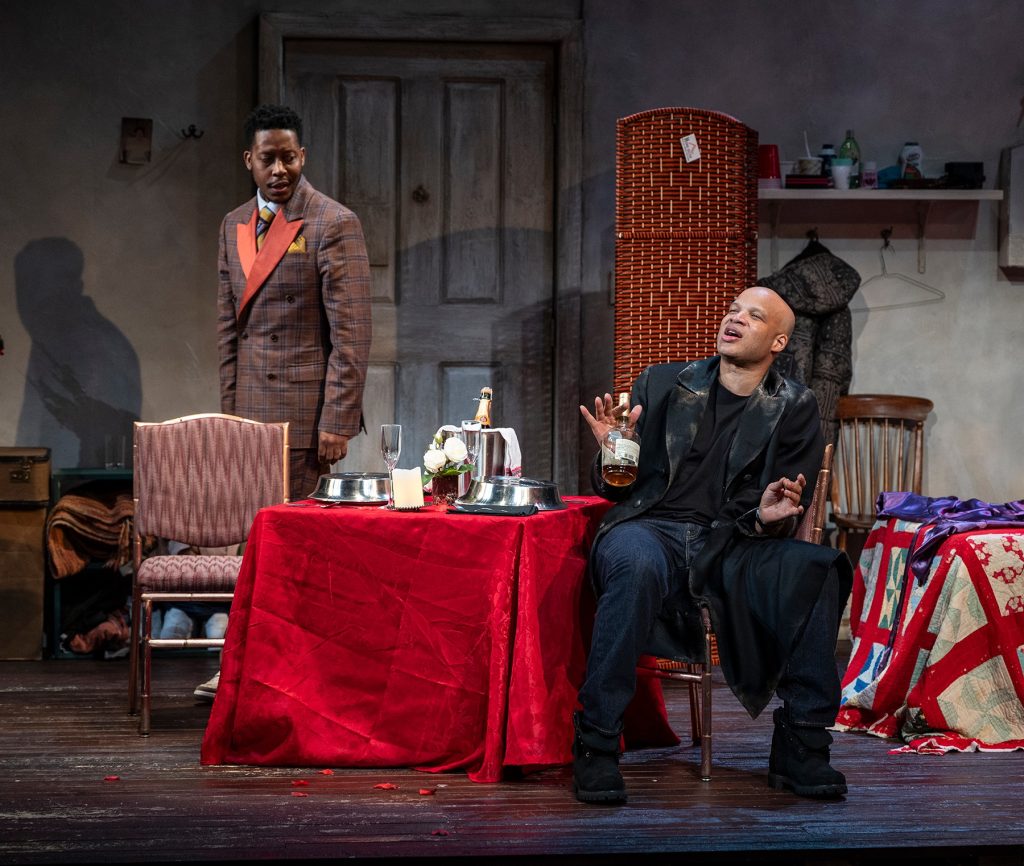
From left, Namir Smallwood as Booth and Glenn Davis as Lincoln in Topdog/Underdog. Photo by Michael Brosilow.
What makes a play a classic? That’s a question that struck me as I was watching the new revival of Suzan-Lori Parks’ Topdog/Underdog at Steppenwolf Theatre Company. Although the play is now 25 years old, it offers at least one answer to that question: A classic play is one that continues to stay vital no matter its age.
Part of achieving that classicism is enough nuance and room for interpretation for later artists to remake the piece to speak to different eras. Topdog/Underdog has some clear ideas at its core — race and identity, family, class and capitalism — but it’s also enough of a blank canvas to allow for reinvention. Before the show starts, the space is dominated by a gold American flag serving as the grand drape. Though it’s deft enough, both in text and presentation here, to avoid obvious sermonizing, director Kenny Leon sees this as a play about American materialism. (In the interest of full disclosure, I should also note that Leon addressed my theatre history class and mentioned this as part of his rationale.)
But that grandiose, golden flag rises to reveal a beautifully rendered shabby flophouse apartment. Arnulfo Maldonado’s set design is painstaking in its realism, from the grimy, neon-lit window to the tetanus-laden sink. It’s a cramped, dank environment that will serve as a pressure cooker for our two larger-than-life protagonists. Sometimes the size of the playing space feels overly restrictive (I think it was about half the actual stage space), and picturesque tableaux are hard to come by in such confined quarters.
But the art of directing is about more than crafting beautiful stage pictures, and whatever this tiny sweatbox of an apartment lacks in scale it makes up for in intensity. Booth and Lincoln ricochet off each other and the walls, often nearly on top of one another, the subtle struggle at the core of their brotherly bond rendered visually. Both these men have huge dreams, and it’s clear from the jump that this home isn’t big enough for the two of them.
I was initially frustrated by the confined sense of space, and I felt like it hampered the visual storytelling. But as I’ve turned the play over in my head since seeing it, I’ve come to appreciate the way these design elements reinforced this production’s specific reading of Parks’ text. The United States’ national mythology tells citizens that anyone, regardless of the circumstances of birth, can achieve greatness. All that you need is determination and a willingness to work hard. Leon’s production plumbs the depths of that myth, using the story of Booth and Lincoln to look at the extremes people can be pushed to in the name of securing wealth and the respect that comes with it. This Booth and this Lincoln are crabs in a bucket, clawing viciously to escape. Put another way, the production asks, when you live in a society that only values money, what good is family?
Bringing the pair to life are Steppenwolf’s artistic director, Glenn Davis, as Lincoln, and ensemble member Namir Smallwood as Booth. The pair have incredible stage chemistry together, and even if it offered no other pleasures, this production would be a masterclass for anyone interested in the art of stage acting. The Steppenwolf aesthetic, with its commitment to razor-sharp, visceral acting that hits you in the gut, is alive and well in their hands. Under Leon’s direction, Davis and Smallwood dig into every nook and cranny of these characters, breathing life into them in a way that’s so immediate and so absorbing that the play feels much shorter than its two-plus hour runtime.
The brilliance of the text is the play’s central, animating metaphor. As we meet Booth, he’s practicing his sleight-of-hand and rhetorical showmanship in anticipation of launching a hustle as a three-card monte dealer. The play itself functions as a confidence game, leading the audience’s attention one way before yanking the rug out from under us. As the title suggests, one of these brothers is the top dog and the other is an underdog. But are we certain we can tell which is which?
Smallwood’s Booth is all braggadocio and bluster, dominating the small apartment and controlling his brother. Lincoln, though he’s the only one of the pair with a job, allows himself to be manipulated by his younger brother. As Booth, Smallwood is larger-than-life, spinning elaborate dreams and lies about his vision for himself. In one bravura turn, we see him return from a mission, laden with the spoils of a shoplifting spree. It’s staged brilliantly, and Smallwood gets every possible laugh from the various places he’s secreted everything from belts to full suits.
This dominance of the space extends to his relationship with Lincoln. When Booth demands the shrimp dish from the Chinese food Lincoln bought, the elder brother backs down. And when Booth takes more than his share of Lincoln’s paycheck, the older man again relents. Davis has a striking ability to withdraw within himself and to cede ground to avoid confrontation. The sight of him slinking around, clad in a raggedy coat, shabby Lincoln beard, and pancake makeup from his day job impersonating the 16th president sets him up as the clown to Booth’s straight man.
But we can tell that, perhaps, this relationship isn’t so straightforward when we see them handling the cards for the three-card monte game. Lincoln used to run a crew hustling easy marks, and when he deals the game, he’s so much more deft and fluid in his handling of the deck and his speech that we get a glimpse into what might be the real, underlying power dynamic. And as we build to the sickening finale, the uproarious hijinks of the early play curdle into a sour, gut-wrenching finale. The grim finish is itself a sick parody of a moment of fun between the two brothers early on as Booth coaches Lincoln on how to pretend to die better for his job as a Lincoln (the president) impersonator.
The production’s only real flaw is the strangely inert nature of the climax. I’ll try to avoid spoilers here (although Parks gives you a pretty good idea what’s going to happen based on the character names), but there’s a classic Chekhov’s gun that goes off as the action comes to a head. In this production, the moment is badly undermined by the lack of a firing weapon. I understand that it’s more logistically difficult, but a sound effect doesn’t have the same theatrical power as a practical weapon. After two hours driven by stellar, nuanced performances from both Davis and Smallwood, the play’s devastating end lands a bit too lightly to serve the story well.
Still, this ultimately is a small-stakes quibble after a tour de force from the play’s two leads and an otherwise moving, visceral exploration of the way our country’s madness works its way into our homes. A quarter-century after its debut, Topdog/Underdog still has something to say.
Topdog/Underdog is running through November 1st at Steppenwolf Theatre Company, 1650 N. Halsted, Chicago, IL 60614. Tickets available at the website. Find more information about current plays on our Current Shows page and at theatreinchicago.com.