
By Kyle A. Thomas
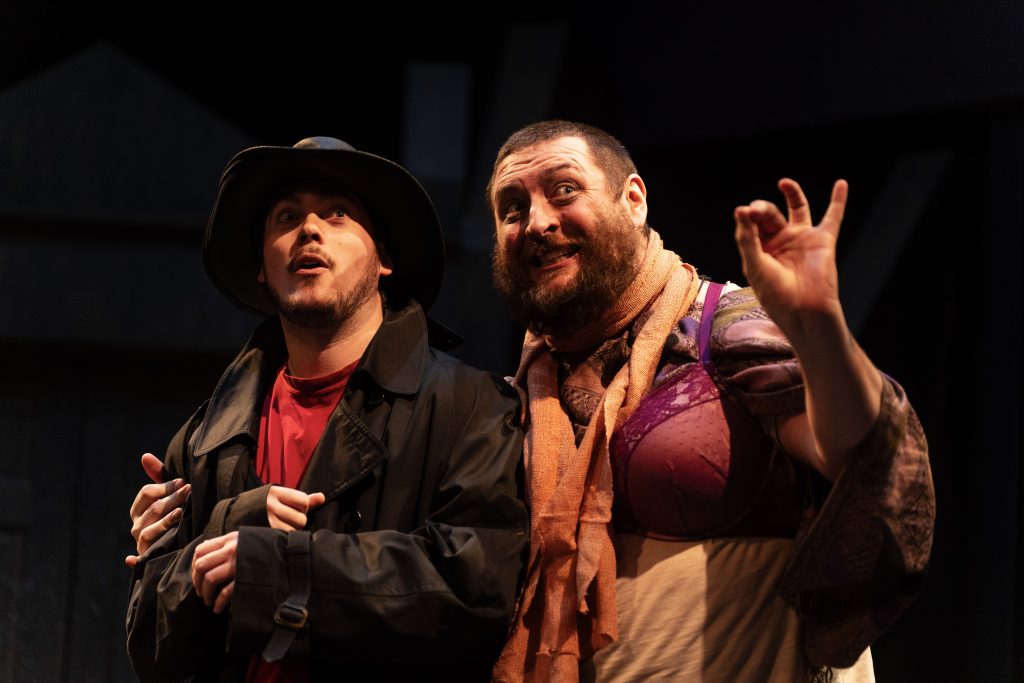
Director Charles Askenaizer expresses in his program note that The Winter’s Tale by William Shakespeare is a story about second chances, realized only when the journey of time leads us well beyond the initial error of our ways. And that analysis resonates well amongst the unique qualities that make this one of Shakespeare’s more challenging plays to interpret. The story takes a sixteen-year jump in the middle, shifts from courtly drama to playful pastoral then back again, and momentarily features a—somewhat random—bear who chases a character off stage before killing him. Second chances, being what they are in The Winter’s Tale, don’t come on the heels of error but wait in the wings while a series of lamentable events befall those who were witness to the expositional wrongheadedness only to find themselves bound to its unfolding misfortunes.
Combined with the comical plotlines involving the many frivolous and foolish characters of Bohemia, the bow that ties everything together comes by way of second chances. The play opens in the midst of the countdown to the New Year. We witness the loving exchange between the King of Sicily, Leontes (Michael Stejskal), and his very pregnant queen, Hermione (Andrea Uppling) just before Leontes is abruptly struck with immense jealousy at the sight of Hermione’s playful exchange with his longstanding guest, Polixenes (Raúl Alonso), the King of Bohemia. Leontes then demands that his nobleman, Camillo (Kim Pereira), poison Polixenes but, instead, Camillo warns the Bohemian king and flees with him. Leontes then publicly accuses Hermione of infidelity, claiming that she is carrying an illegitimate child, and has her imprisoned. Her loyal confidant, Paulina (Amber Dow), helps with the birth of a baby girl and takes the child to Leontes, who becomes even more convinced of her deceit upon seeing his daughter. He demands Hermione be executed, but before the sentence can be carried out, their son, Mamillius (Jennifer Agather), and Leontes’s heir, is said to have died from the harrowing events unfolding around him. Upon hearing this, Hermione collapses, seemingly dead, into Paulina’s care. Fast forward sixteen years and Hermione’s daughter (also played by Jennifer Agather), who was banished by Leontes to a foreign land (that turns out to be Bohemia), has been raised by a kindly shepherd (Cuck Munro). Named Perdita, she is secretly pursued by King Polixenes’s son, Florizel (Robert Hunter Bry). During a raucous sheep-shearing festival, King Polixenes reveals his knowledge of Florizel’s frivolous love affair with Perdita and forbids him from marrying a peasant girl. As with all good young lovers of Shakespearean fame, they flee Bohemia for Sicily and seek refuge with a now older and deeply remorseful Leontes. He welcomes them to his court, only for Polixenes to arrive with Camillo and demand they return to Bohemia. But, after the revelation that Perdita is the long-lost daughter of Hermione and Leontes, the two kings reconcile, and the amoretti are given their blessings to marry. Immediately following this joyous occasion, they all visit Paulina to witness the unveiling of a new statue dedicated to Hermione and expertly sculpted in her likeness. Leontes is deeply moved upon seeing it and when he goes to touch it, the figure slowly comes to life. Hermione is thus reunited with Leontes and all set off, renewed in their second chances, to see Perdita and Florizel married.
Regrettably, Invictus Theatre Company will need to take a cue from Shakespeare’s play and find a time in the future to take a second chance at The Winter’s Tale. Askenaizer’s direction makes for a disjunct experience that vacillates from the inexplicable icy gravity of a jealousy-ridden king in the first half of the production to a hippie-esque Bohemian bacchanal in the second half before closing on the gravity of a memorial service turned somber reunion. While Shakespeare’s play makes for some rather sudden affective turns and challenging character choices for actors, the earnest direction of the work makes King Leontes’s “horrific and inexcusable” (to quote the director’s note) actions a problem for the audience to overcome rather than increasingly join with the theatrical world in seeing him as object of satirical ridicule. Shakespeare saw his audiences as participants in the dramatic action of his plays, not only requiring their presence in enacting the magic of theatre but also demanding they affect the performers in their presentation of the story. Yet, we are left merely as passive witnesses to the unfolding events of The Winter’s Tale. Even in the soliloquies, we are presented with information rather than engagement (with a clear exception that I will return to momentarily). And the staging does not help with the disjointed experience. The major action takes place upon a raised circular area framed by vertical lighting (designed by Trey Brazeal) that does feature fantastic visual effects. But the pastoral rurality necessary to set the second half of the production is signaled by greenery largely shoved to the side of the main stage while a handful of actors, who double as instrumentalists for a very lovely score (composed by Petter Wahlbäck), are pushed into a back corner of the space. We are asked to see these areas as differential spaces with definitive boundaries that not only don’t exist but also variably affect the actors’ performances as they move from one role to another throughout the space.
Even the moments that shine through seem plucked from other, more successful, works by Shakespeare, distracting us momentarily from the weightedness that bookends The Winter’s Tale. Sam Nachison as the clownish Bohemian, Autolycus, is a show-stealer in all the best Shakespearean ways. Nachison expertly engages the audience with brash but infinitely lovable soliloquies. Nachison’s performance encompasses us within the theatrical world, playing into the knowledge that we know this is theatre—and what fun can we have with that knowledge? One of the best bits of the show occurs between Autolycus and the young shepherd (Kyle Quinlivan), when the former procures the clothes of the latter in increasingly humorous acts of misdirection. Andrea Uppling’s portrayal of Hermione is powerful and moving. And Amber Dow brings a fierce power to Paulina, who you cannot help but root for as she works to sway Leontes.
If you love Shakespeare, there is something to find in this production of The Winter’s Tale that is satisfying. Invictus Theatre Company is certainly working to infuse Shakespeare with novel and inventive approaches. But the attempt here feels very uneven.
The Winter’s Tale by William Shakespeare plays at the company’s home at the Windy City Playhouse (3014 W. Irving Park Road) from March 11 – April 20. Performances are Fridays, Saturdays, and Mondays at 7 p.m., Saturdays and Sundays at 1 p.m. Ticket prices are $25 for Monday and $38 Friday through Sunday. Season subscriptions available. www.invictustheatreco.com