
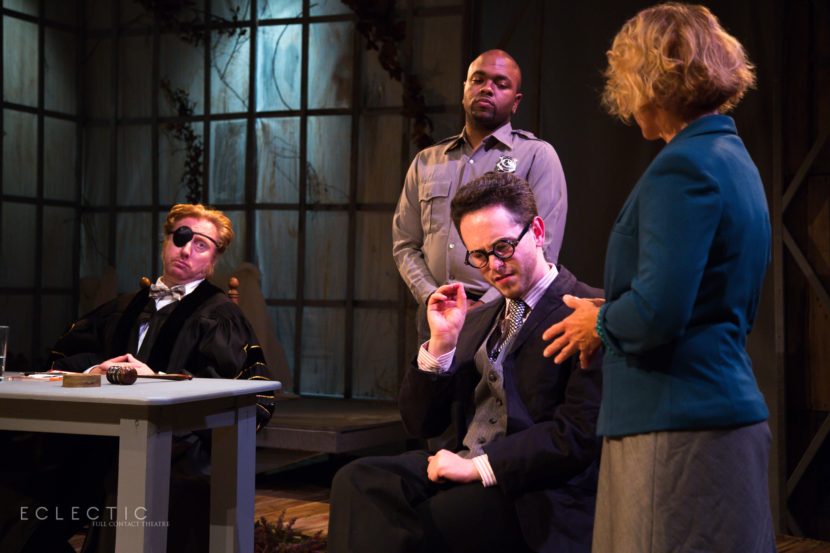
 In The Last Days of Judas Iscariot, Stephen Adly Guigis dares to explore some of the biggest philosophical and religious questions in the history of Western culture, and though his play doesn’t provide any definitive answers it certainly isn’t for lack of effort. When done well—and this Eclectic Theatre Company production is done very well—this play is designed to have audiences arguing its philosophical and spiritual ramifications all the way home.
Performed on a steeply raked stage designed by Jeremy Hollis, The Last Days takes the form of a kind of appeals trial for its title character, who has been languishing in a small room in hell for the last 2000 years. A zealous defense attorney, Fabiana Aziza Cunningham (Julie Partyka) doggedly fights with a stubborn Purgatory judge (Andrew Pond) until he is worn down enough to allow the hearing, which is not attended by Cunningham’s client (Alexander Utz). That doesn’t stop her pursuit of justice, though, as she calls witness after witness to the stand to prove that, in the play’s terminology, Judas was “fucked.”
This is a play full of Big Ideas. The very idea that we should not hold Judas responsible for what he did is big enough, but this play also takes on the role of motherhood, the argument for the duplicity of Mother Theresa, the existence (or not) of Satan, the validity of the Biblical accounts themselves, the notion of free will (is it “a design flaw”?), the concept that Jesus may have been culpable in his own death, and several other complicated issues, any of which might have been fodder enough for its own play. But Guigis tackles them all, head on, in a bold, experimental narrative that sees characters both within and outside of the courtroom coming and going as they address themselves to us and tell their stories.
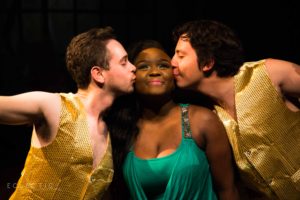
Among the standout members of this huge ensemble is Amber Sallis as Saint Monica. Ebullient beneath a thick layer of eye sparkles, Sallis is a force of nature. She comes in like a comic tornado, bragging about her powerful nagging abilities (she got God to keep the trial alive when the judge wanted to dump it) and her son, St. Augustine, and when she visits Judas in hell she tries to “break him” with every possible pun on “30 pieces of silver” and “hanged himself on an olive tree.” (Yes, there are way more than you’d think.) But as she is going along, it is Monica who breaks: Judas doesn’t move at all except for one red tear sliding down his face, and she sees that “sadness ran through him like a river.” If God cares for the least of his creatures, she tells us, well, this is “the leastest creature I’ve ever seen.”
Kelly Levander’s Henrietta Iscariot breaks our hearts from the start of the play.
I buried my son. In a potter’s field. In a Field of Blood. In empty, acrid silence. There was no funeral. There were no mourners. His friends all absent. His father dead. His sisters refusing to attend.
She goes on to tell us that from the moment Judas was born, she “was infused with a love beyond all measure and understanding.” This love clearly did not end with his betrayal of Christ. A mother’s love is unconditional.
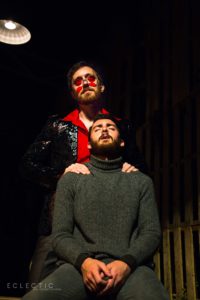
As Satan, a figure who twice needs to be “conjured” because it is not clear that he truly exists (he is after all the Prince of Lies), Michael Woods gives an appealing, intense performance enhanced by Catherine Tantillo’s outrageous costuming. A scene in which he meets up with a terrified Judas in Judea after the betrayal is brilliant, with both actors working the moment for all it has. And there is even a bit of the “ruler of hell” Satan in a frightening outburst in the courtroom. This is not “Lucifer” from the TV show. If he exists, you don’t want to meet this guy.
The thing is, though, that even Satan agrees that, whatever Judas’s deeds are worth, his punishment is self-imposed. He is free to leave whenever he desires, but he has succumbed to despair. We are told—twice—that Thomas Merton said this about despair:
Despair is the ultimate development of a pride so great and so stiff-necked that it selects the absolute misery of damnation rather than accept happiness from the hands of God and thereby acknowledge that God is above us and that we are not capable of fulfilling our destiny by ourselves.
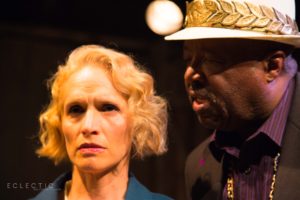
Despite the fact that Cunningham professes to be unsure of God’s existence, the play has no such qualms. On Satan, it hedges its bets. On God, though, it is firmly in the “yes” column, though it isn’t entirely certain what kind of God. What kind of God, after all, would allow a “design flaw” like free will and then create an equally flawed “self-correction” to fix it? What kind of God leaves Judas in despair, asks Cunningham: a useless one or a powerless one? Neither seems a palatable option.
As Cunningham, Partyka has quite a job to do. She is ostensibly trying a case for the absent Judas, but one gets the strong sense that what she is actually doing here is pounding the ground to seek answers to her own confusion, the same lack of faith that keeps her in Purgatory in the first place. And the more the answers make no sense—for how can they?—the more frustrated she becomes.
Another actor who is onstage most of the show is Pond, whose Judge Littlefield is here in Purgatory because he hanged himself on the battlefield. His own frustration comes out in his anger and a hundred gavel slams. But it is perhaps as Caiaphus the Elder (“Is there a Caiaphus the Younger?” “No”) that he truly distinguishes himself. Fighting every inch of the way to prevent Cunningham from getting to the real truth about Jesus’ trial, he holds on deeply to that anger and pain he lets out as Littlefield. And as the scene progresses to the point where he can hold it no longer, he becomes what any attorney does not want: an uncontrollable force on the witness stand. It’s the second time in a row for Cunningham: she had the same result with Pontius Pilate (George Stallings).
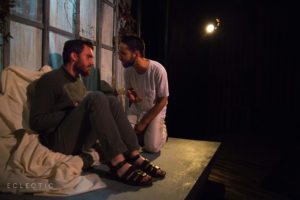
It takes a good director to keep all of this chaos in line, and David Belew is more than up to the task. As people come and go, he keeps the scenes rolling along, using every possible entrance and exit to do so (giving headaches, I’m sure, to Stage Manager Michael Starcher, who keeps that ball rolling beautifully), and he gets phenomenal performances out of a perfectly cast and very, um, eclectic group of performers. (Kudos to casting director Jessica Fisher.)
All of the play’s scenes take place under the watchful eyes of Jesus (Joaquin Rodarte), a silent presence who comes and goes until near the end and who clearly knows everything. Of course he knows what will happen in this trial. And he knows, as does the audience if we think about it, that it will not matter at all. Another dead man, Butch Honeywell (Andy Blaustein) tells Judas that WH Auden said that “God may reduce you on Judgement Day to tears of shame reciting by heart the poems you would have written had your life been good.” Judas’s tears come infrequently, and we know they are red.
The Last Days of Judas Iscariot is being presented by Eclectic Theatre Company at Athenaeum Theatre in Chicago through Oct. 29. Tickets are $27-32. Find more information about this and other plays at theatreinchicago.com.
chicagodramagirl