
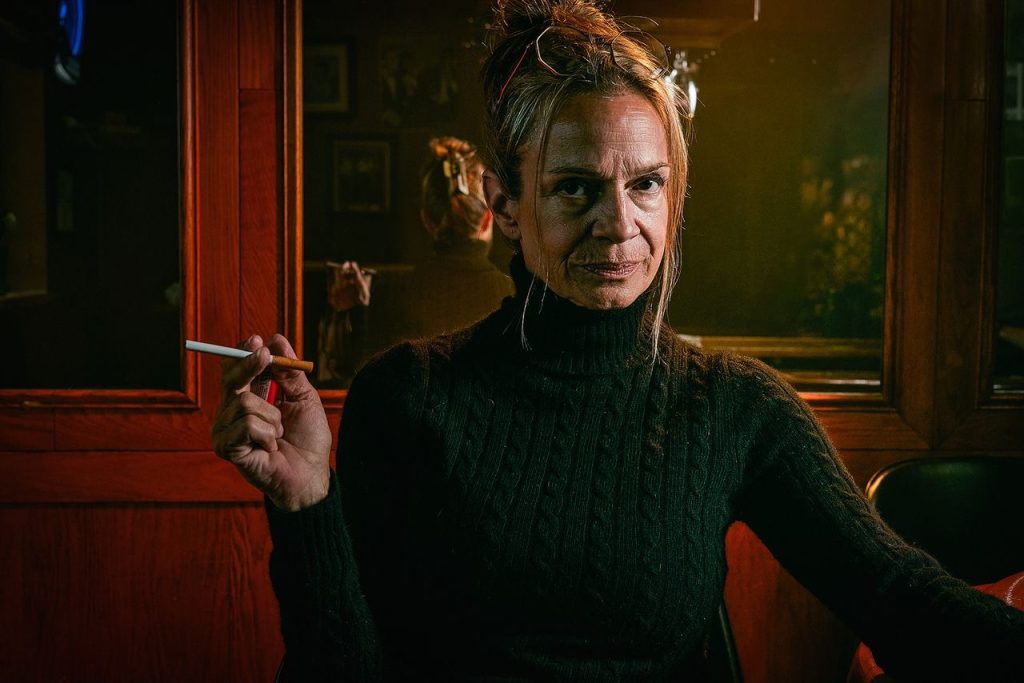
Photo by Jeff Kurys
A man in power desperate to keep it. A society that seemingly has no idea how to prevent political corruption. Apathetic people pushing the system along. A journalist who finds herself increasingly alone and in danger in her journey to make a change.
It isn’t the modern-day U.S., but sometimes it feels that way.
Vladimir by Erika Sheffer, directed by Lou Contey, is set at the turn of the century and 2004 in the beginning of the titular Vladimir Putin’s reign of Russia. The play follows the fictional journalist Raya Bobrinskaya (Rebecca Jordan) in her noble but often futile quest to report on the corruption in the Russian government and the happenings of the Second Chechen War, fought between Russia and Chechnya from 1999 to 2009. Along the way, Raya must deal with her daughter’s (Isabel Alamin) wedding, her boss and significant other’s (Adam Schulmerich) defection to apathy and a source (Tristan Odenkirk) increasingly committed to helping her in her cause.
Vladimir is intense and complicated; something that is difficult to sustain for over two hours. It also, perhaps, places too much trust in the knowledge the average American has about Russian geography and politics — I was relieved when an audience member next to me leaned over to ask her seat mate where Chechnya actually was, because I was worrying that I had somehow missed something in my schooling back in Maryland. There were also several times where the characters spoke in Russian without any translation, and I just had to resign myself to having no clue as to what was just said.
Despite the play dragging a bit, though, and being overall a lot to follow, it packs a mean punch. The Sunday matinee crowd was particularly boisterous, and several of the more philosophical lines about political apathy and personhood received more than a few thoughtful hums from the audience. Contey is precise and methodical in his direction — the transitions between scenes are often complicated and long, but Contey livens them up with a figure in black directing the movement of tables, chairs and people with a red laser pointer as well as vaguely Russian music that keeps one’s attention piqued.
The most memorable part of Vladimir is not necessarily its performances (although the ensemble is very solid and achieves a huge amount of laughter) or its plotline, but its ideas. Raya’s struggle is more metaphorical than real, and the play’s commentary on modern U.S. politics is entirely unmissable. What stuck with me most was Raya’s unfettered and bold willingness to speak to the hard truths that real people outside of fiction are often too scared to verbalize. In one scene, she sits with Odenkirk’s Yevgeny after a politically motivated massacre where an attack on a school left hundreds of children, teachers and parents dead (a real event — the Beslan school siege). When Yevgeny calls the perpetrators monsters, Raya refuses to agree. Jordan is steadfast and dry in her response, telling Yevgeny that they are people who have never been treated like the human beings that they are. It isn’t an exciting truth, but that’s the center of this play: to truly make a difference, we have to prevent people from committing acts that make them into “monsters.” It isn’t enough to simply condemn them once they are already there. Maybe it will never happen, but when people like Raya push to make a difference, maybe it will.
Vladimir is now playing at Theater Wit presented by Shattered Globe Theatre, at 1229 W Belmont, Chicago, IL 60657, until November 14, 2026. Performance times vary; check the website at Theater Wit. Find more information about current plays on our Current Shows page and at theatreinchicago.com.