
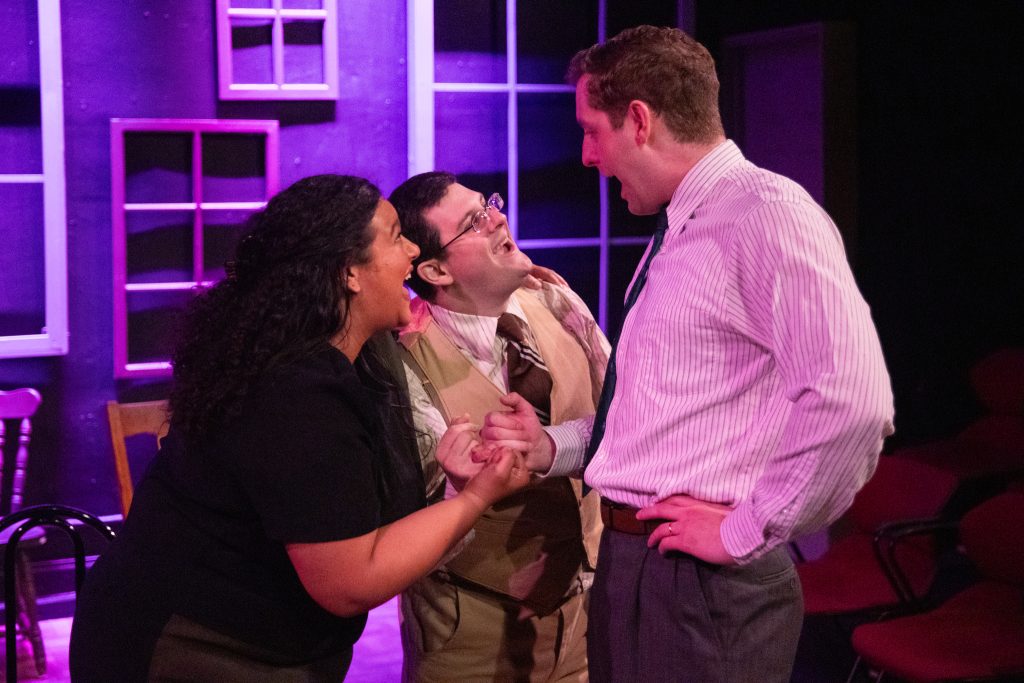
Photo by Eli Van Sickel/VanCap Images
In a shoebox-sized space on Thorndale Ave. called (though no signage exists to confirm this if you don’t already know) the Reginald Vaughn Theatre, Blank Theatre Company specializes in reenvisioning big musicals and making them small. Their latest production takes a show that is just now getting its second chance on Broadway, Stephen Sondheim’s shamefully underappreciated Merrily We Roll Along, and—as they did with last season’s She Loves Me—redefining what can and cannot be done in Chicago’s many storefront theatres. Since they don’t come much smaller than the Reginald Vaughn, don’t expect much in terms of spectacle from this Blank production, but the company more than makes up for that in heart: this tiny space, where the audience is mere inches from the performers on three sides of the stage, comes alive under director Danny Kapinos as this play rolls backward through the years to show how a great friendship can be crushed under the weight of ambition.
Christopher Johnson stars as Franklin Shepard, the outsized musical talent whose outsized ego destroys the best things he’s ever had: his marriage to someone who really loves him, Beth (Justine Cameron), and then his long-term friendships with Charley Kringas (Dustin Rothbart) and aspiring novelist Mary Flynn (Brittney Brown).
At the start of the show, Franklin is in Hollywood in 1975 with a large group of sycophants, producers, and hangers-on celebrating the opening of the new movie he has scored. If it were not for the presence of a drunker-by-the-minute Mary, we’d never know that this is in fact a celebration of selling out: Frank has betrayed Charley, his lyricist and writing partner, and his own dreams of Broadway success in favor of the fantasy of Hollywood money and fame. (Sondheim presents this as something like a dream itself: even if you can find it, it is impossible to grasp and hold onto…and you’re totally on your own as you try to do so.)
This central threesome of Frank, Charley, and Mary forms the core of the show, but two other women are equally important: Beth, who comes into Frank and Charley’s lives when she auditions for a politics-themed revue they are creating and eventually becomes Frank’s wife and the mother of his son; and Broadway actress Gussie Carnegie (Brandy Miller), a woman who sees Frank’s genius, wants a part of it, and has no problem being an adulterer and home-wrecker to get it if she can attach herself to a rising star.
Throughout the play, we follow the journeys of these people, watching their connections unspool as key events are played out and the ensemble counts backward through the years. Key to that unspooling is a TV interview done by Frank and Charley. Charley is hoping that his “old friend” will be coming back to work on their next musical now that he has his Hollywood fame assured…unaware that Frank has just signed a multi-picture deal. He discovers Frank’s selfish deception just before going on air and launches into a tirade during the interview in which he calls out the betrayal in a patter song about how Frank has become a slave to money and has no time left for anything real. “Franklin Shepard, Inc.” is an explosive number about selling one’s soul, and Rothbart handles it superbly. Equally wonderful are Brown’s public teardown of Frank in “Now You Know” and Cameron’s plaintive and frustrated “Not a Day Goes By.”
Kapinos has his ensemble move fluidly about the small stage, and sometimes it seems amazing that they don’t knock each other over (which they surely would if it were not for careful blocking). A tiny offstage orchestra under musical director Aaron Kaplan provides the music; though the sound is a bit thin, it works well enough as the actors’ voices take control. The set is simple: a back wall covered in windows of various sizes, possibly alluding to the way that the play is structured as quick glimpses into their lives through the years. The only furnishings are chairs that the actors move around, yet they are able to conjure many different locations and moments, including the wonderful final scene on a New York rooftop in 1957, as they all come together for the first time to watch in awe as Sputnik 1 moves across the sky: surely, they believe, a sign of a new age of incredible harmony and cooperation.
Of course, we know that won’t last; nothing does, not the glorious promise of 1960’s Camelot (which their revue skewers genially), not even the bond between old friends. Even the wonder of Chicago’s storefront theatre scene is ephemeral, as we learn watching more and more stalwart companies forced to shut down, but as long as productions like this one can continue, hope springs eternal.
Merrily We Roll Along is a Blank Theatre production now playing at Reginald Vaughn Theatre, 1106 W Thorndale, until July 23. Tickets are available at blanktheatrecompany.org. For more Chicago reviews or show information, see chicagoonstage.com or theatreinchicago.com.