
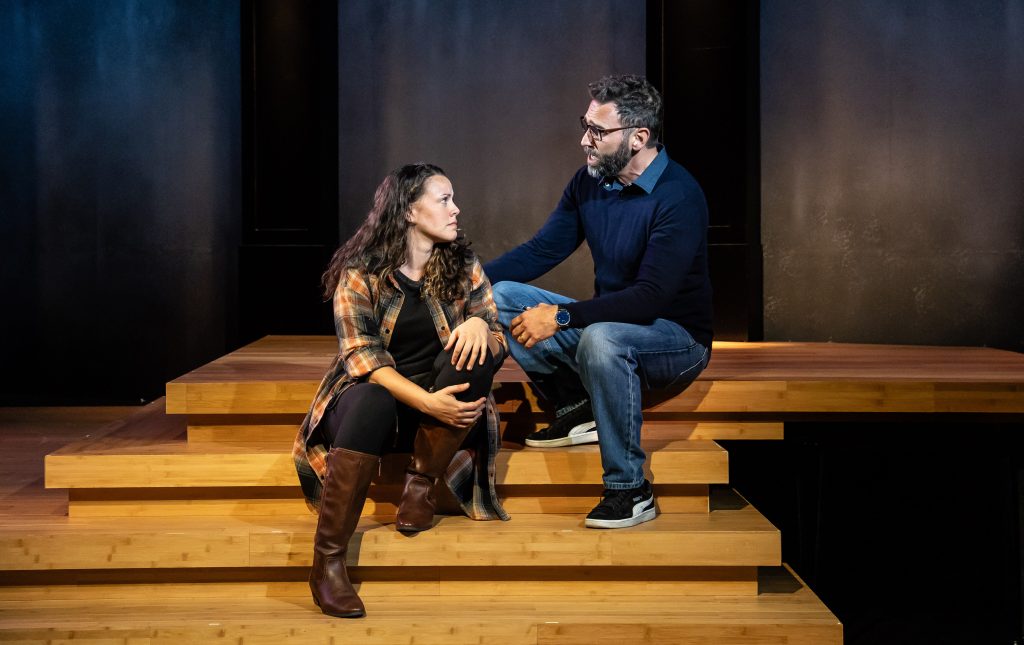
Photo by Liz Lauren
“Who’s crazy, the one who can’t cope? Or maybe, the one who’ll still hope?”
This is a central question asked in Tom Kitt and Brian Yorkey’s Next to Normal, the Pulitzer Prize-winning musical about a family that has been broken by the death of an infant boy followed by the descent of his mother into bipolar delusions that keep the boy “alive” in her refusal to accept reality…and the struggles of her husband and daughter to deal with the ways in which her pain overflows and impacts their lives. It’s a brilliant show that I have seen many times, but the Jim Corti-directed production currently playing as part of Paramount Theatre’s Bold Series is without a doubt the best I have ever seen.
Maybe it is a result of staging it in the intimate Copley Theatre, across the street from the Paramount, which gives the whole audience virtual front-row seats to this intensely personal show that allow them to experience all of the whirling emotions with the characters. Maybe it is due to Corti’s always-inventive direction that the show, whether it is crackling with furious energy, gazing deep into the splintered souls of the Goodman family, or stepping back to comment on the difficulties of trying to cope with mental illness, seeps into the soul and clings there, unwilling to let go.
Yorkey’s powerful book, with its refusal to pull punches and its often-searing descriptions, as well as its more than welcome gentle, tender, and, yes, humorous moments—many of these—takes us into this family just trying to survive what Lin-Manuel Miranda, in Hamilton, called “the unimaginable.” Mostly, we are seeing through the eyes of Diana (Donna Louden), the bereft mother who compensates for the loss of her toddler son by maintaining a relationship with him—he is now much older in her mind, of course—though he himself acknowledges that “When I appear it’s not so clear if I’m a simple spirit or I’m flesh and blood.” Among the ways she portrays this to the audience are talking with him about his school day, setting a place for him at the dinner table, and even dancing with him.
The “spirit” of Gabe is played by Zake Ziman, whose vocal skill, projected energy, and surfeit of teenage attitude proudly proclaim that his character knows “who I am.” He has a rather difficult job here: he interacts with all of Gabe’s family members throughout the show even though we know from early on that, as father Dan (Barry DeBois) says, “He’s not there.” Ziman perfectly portrays this manipulative, me-only, id-only character in order to make him sympathetic to the audience (beyond the early death, which is a gimme). And of course we want to like him, even though Diana (reacting to her fantasy that he is alive) describes him as a “shit.” (He’s very needy, but probably not that bad.)
The other member of the family is a younger sister, conceived—though no one will say it out loud—to replace the dead baby. Natalie (Angel Alzeidan) is a “genius” both in academics and on the piano. But she is constantly haunted by her mother’s madness and the brother she can never hope to replace in Diana’s mind. Her mother even tells her, during the beautifully sad “Superboy and the Invisible Girl,” in which Natalie desperately wishes that things could be different, “You know I love you. I love you as much as I can,” which, of course, only confirms her pain. (Diana does at one point, later on, comprehend how difficult she has made Natalie’s world: “Your life has kind of sucked, I think,” she says in a lucid moment when memories leak through clearly.) Alzeidan is excellent as the messed-up child of a messed-up mother. Reacting to Diana, she can exude love and hope in one moment and then have it dashed to pieces by frustration and anger the next, playing opposite emotions within seconds while never losing track of the reality that nothing will or can ever change.
Her father, in his desperation to bring things “back to better than before,” encourages Diana to undergo every possible treatment from drugs to electro-shock therapy (all of which allows Devin DeSantis to have loads of fun playing the different doctors). But he doesn’t know how deep her wound is. Even though he is “so steadfast and stolid and stoic and solid for day after every day,” he can’t really even conceive of the hell of her life. Even when she asks him, “Do you read obituaries and feel jealous of the dead?” he still believes there is a way to go forward. But Diana, after her treatments, begins to wonder if it is hopeless. “What happens if the cut, the burn, the break was never in my brain, or in my blood, but in my soul?” she sings, as DeBois looks on, a man whose whole world has just broken.
This particular production of Next to Normal relies almost entirely on its gifted ensemble to deliver the powerful emotional experiences that the Goodmans go through. Celia Villacres’ six-piece band delivers a huge sound that underscores Diana’s psychotic breaks as well as an intimate one that allows us to feel the quieter emotions that Tom Kitt wanted us to understand. (Music Director Kory Danielson certainly had a hand in that.) Michelle Lilly’s stage design opts for a series of interconnected platforms to stand in for all of the locations, so there is no multistory set with sliding walls, as in the original Broadway staging, to rely on. In this intimate space, it is an excellent decision: it forces the actors to rely on themselves and each other.
The result of this is that this is, from top to bottom, the perfect version of this show (barring a trip back through time to see the Alice Ripley-led original). And it is also the only version I’ve seen in which the pain and emotions of every character are treated equally. Louden, whose voice reminds me of Ripley’s, leaves nothing at all onstage. Even though Diana, since Gabe’s death, can only allow herself to feel through her fantastical images of her boy, Louden shows throughout that other emotions are there. It’s clear, for example, that Diana, when she is lucid, knows the sacrifices Dan has made, even if she can’t always acknowledge them. She realizes that Natalie’s life has been awful and that she is the cause, and Louden allows that emotion to escape in a beautifully understated moment.
All of these actors are just as perfect as the show is. In too many productions, for example, Dan, as well as Natalie’s semi-stoner boyfriend Henry (played here by a winning Jake DiMaggio Lopez) seem to fade into the background against the lead women, probably due to the audience’s recognition of the hopelessness and desperation of their goals. (Heck, even Kitt and Yorkey seem to acknowledge this, as both men’s songs are repetitive in structure and often sweet to the point of being sappy: Henry is mostly played for gentle humor, and even in Dan’s most pained moments, when his despair shines through, he can’t come close to the stunning power of Diana’s songs.) Here, DeBois shows us Dan’s confusion, pain, unfounded optimism, and desperate love every moment he is onstage. DiMaggio Lopez gives us a Henry who easily moves past his initial aspect (the introverted stoner who can’t believe that Natalie will even give him the time of day) to someone worthy of all of her love.
By the time Natalie tells her mother that “I don’t need a life that’s normal/ That’s way too far away/ But something next to normal would be OK,” we can see through her years of anger at a mom who has always been so deep in psychosis that there was nothing, no matter how perfect, that the daughter could do to break through. In the end, everyone finally understands that life does not always get better. People like to bandy about statements like “What doesn’t kill you makes you stronger.” But sometimes the best you can hope for is to realize that, as this show tells us, “What doesn’t kill me doesn’t kill me,” and know you have to go on no matter what.
Next to Normal is playing at Copley Theatre, across the street from Paramount Theatre,
23 East Galena Blvd Aurora, until Sep 13. Tickets are available at the Paramount Theatre website. For more Chicago reviews or show information, see chicagoonstage.com or theatreinchicago.com.