
Photo by Liz Lauren
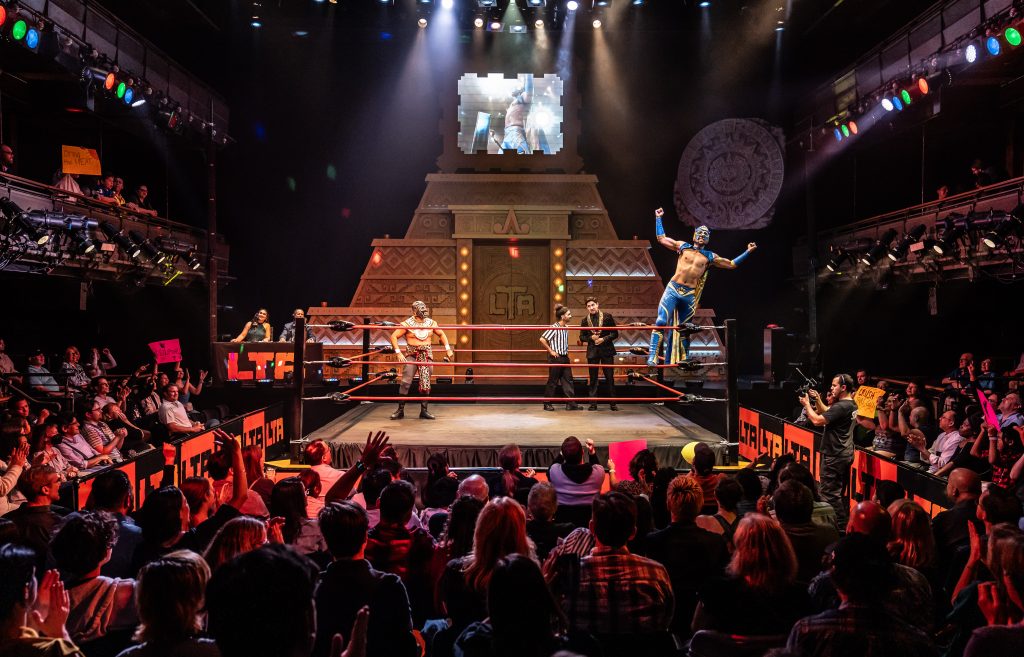
There was Aztec dancing in the Goodman Theatre lobby before the press opening of its new show Lucha Teotl. Bar drinks had Mexican themes (and ingredients). Patrons were invited to stop and make signs to cheer on the Luchadores. In the theatre, which had been transformed into a wrestling ring with a huge golden Aztec-like pyramid backdrop (designed by Anna Louizos and creatively lit by Jason Lynch), an emcee (Víctor Maraña) invited everyone to cheer, boo, and yell back at the actors playing the wrestlers.
Welcome to the world of lucha libre. Whatever you might think about professional wrestling, this is that to the max. And, of course, in this form, it is also a play. So is professional wrestling, I hear you say…and I can’t argue. But whether or not the outcome is predetermined, this kind of theatre requires real athleticism, and many of the cast members are actual wrestlers as well as actors. Watching them leap, roll, flop, and throw each other around the ring for most of the show’s 90-minute length, I could see many of the “stage fighting” elements, but I came away thoroughly impressed. Even the referee (Jean Claudio) was amazingly agile, and I’m sure he gets a great workout every performance.
This is not just a pro wrestling match, though, or even just a play. It is a remarkable immersion into a cultural phenomenon that most of the Goodman’s audience will be exposed to for the first time, and co-creators and co-directors Christopher Llewyn Ramirez and Jeff Colangelo are absolutely cognizant of that. Throughout the evening, we learn about Aztec mythology—the wrestlers represent various gods, and there is notable enmity between those representing the families of the moon (like Paloma “Starr” Vargas, who has thirteen years of experience wrestling as the “Sriracha Muchacha”) and the sun (Joey Ibanez, whose wrestling name is Kamen MK). We are also introduced to the traditions of the Luchador world itself and even (if we so choose) a bit of the South of the Border tastes we might encounter. (I tried a Hot Mexican Chocolate Cookie, which definitely had a spicy kick, and the Horchacha, a version of the Mexican horchata. Both were delicious.) By the raucous night’s end (Michael Huey’s sound and music design is brilliant, by the way), we have become aware of many of the Lucha traditions, including connections to the gods and those masks.
We have also been thoroughly entertained. As commentators Ramón Camín and Rinska Carrasco provide all the information we might need (in a mix of Spanish, English, and even Spanglish), we are immersed in exciting battles with surprisingly “real” stakes. The luchadores are portrayed here as having a variety of experience from decades in the ring to rookies, and we grow to understand and appreciate both. There are clowns, too, particularly the Rabbits (Molly Hernández and Luis “Aski” Palomino), whose moves are very funny. And all of these are wearing some of the most elaborate costumes Nicole Alvarez has ever been tasked with designing.
I’m not going to get specific about what happens, but the result of this iteration of the Lucha calendar—the play represents the third and final cycle of Lucha events on that calendar, represented by the animated Aztec “clock” on the stage—might just end lucha libre forever. (Told you there were some high stakes. Get there soon or you might miss it! JK.) The bottom line, though, is that Lucha Teotl is an evening at the theatre unlike any other. There have been plays that included wrestling matches before—Shakespeare’s As You Like It, for example—but there has never before been a play completely rooted in the showy, colorful world of Lucha Libre. This show is truly a must-see experience.
Lucha Teotl is a Goodman Theatre production and is now playing at 170 N. Dearborn until October 29. Performance times vary; check Goodman’s website. Find more information about current plays on our Current Shows page and at theatreinchicago.com.