
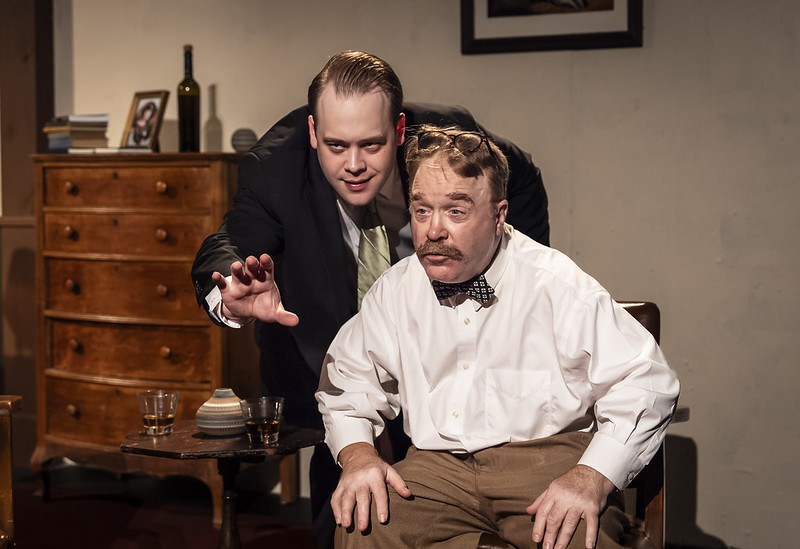
Photo by Liz Lauren
When I first got the invitation to see Lucid Theater’s world premiere production of Amy Crider’s Wells and Welles, the story of a rainy night in 1940 when Orson and HG met, I admit that I first thought it sounded gimmicky despite its being based on a true event.
I could not have been more wrong. It is a compact and unique study of two men who are as famous even decades later, a clash between a brash young American and an aging Brit, and a thoughtful reflection on the nature of art and storytelling.
Crider and director Amber Mandley take us to a small room author HG Wells is renting while in San Antonio as part of a lecture series. The set, designed by Kevin Rolfs, is utilitarian: a bed, a small desk on which sits a typewriter, a dresser, a couple of matching chairs, a couple of non-matching hotel-quality paintings—a decent enough room for a traveling writer, but nothing extraordinary. Wells, played by the similar-looking Pete Blatchford, is trying to get some work done before turning in when there is a knock on the door: Orson Welles, played by Gerrit Wilford (who also bears a nice resemblance to his character), paying an unannounced visit on a damp night.
Welles is seeking an endorsement from the author as he tries to raise money to complete Citizen Kane, while Wells is utterly appalled at the notion of helping the man whose War of the Worlds radio play ripped the heart out of his novel. Welles will not be denied this conversation, though, and from that the play is born.
No gimmickry here, just two men talking about their philosophies of art, its role in their lives, and their unusual connection to each other. Nothing much else happens, but we don’t need it: Welles wants Wells to do a radio interview with him, and that’s about it. (The radio interview is also true, and Crider incorporates part of it into the script.)
This is pretty heady stuff, and maybe it would not work, but the writing is very strong and the actors embody their characters so, um, well that we can’t help caring for them. They both may be famous, but if the playwright and actors could not whip up sympathy for them, the play would be dead in the water. And let’s face it: a 70-year-old curmudgeon of a British novelist who isn’t interested in talking about his fifty-year-old successes and a 25-year-old Hollywood upstart with one accidental hit and no shortage of ego are not automatically endearing characters.
Crider’s 70-minute one-act manages to do it, though, offering glimpses into the minds of these giants that allow us to see both of them more as human beings than as their bigger-than-life self-creations. Oh, Wells is still a fussy man fastidiously insisting that his science fiction books are not the story of his life. And Welles still believes himself to always be the smartest in the room—a dangerous assumption when you’re in a room with a genius author—and is not above a bit of lying to get what he needs. As these two men come to appreciate each other, though, it’s nothing more than remarkable: we start to see truth behind their masks.
Mandley’s blocking here is, to my mind, a bit off-putting at times. She allows Wilford the room to create his character, an homage to a man whom anyone familiar with his films will easily recognize. She allows him to smoothly glide across the room and take up space easily, but she does not seem to afford Blatchford that same opportunity. For an old man, his Wells is almost manic; he won’t sit still for more than ten seconds at a time—which seems odd for a writer—and skulks around his room like a schizophrenic combination of the gentle Eloi and menacing Morlocks from The Time Machine. In addition, Mandley—who would certainly be forgiven had she decided to keep the movement fairly static in a piece like this one—appears to be of the school that believes that stationary is not interesting unless a character is monologuing…and that, as in a musical, all speeches must be directed to the audience. (To be fair, I don’t even like that style in a musical: let actors act, and let people talk to each other if that is what they are supposed to be doing!)
Still, aside from such small quibbles, Wells and Welles, along with its director and cast, acquits itself well. (I couldn’t resist doing that one more time. Forgive me. I’m clearly not well.) It’s a consistently interesting—and even educational—piece of theatre.
Wells and Welles is the first production of Lucid Theater. It is being staged at City Lit Theatre, 1020 Bryn Mawr, until Aug 11. Find more information about current plays in our front page recs and at theatreinchicago.com.