
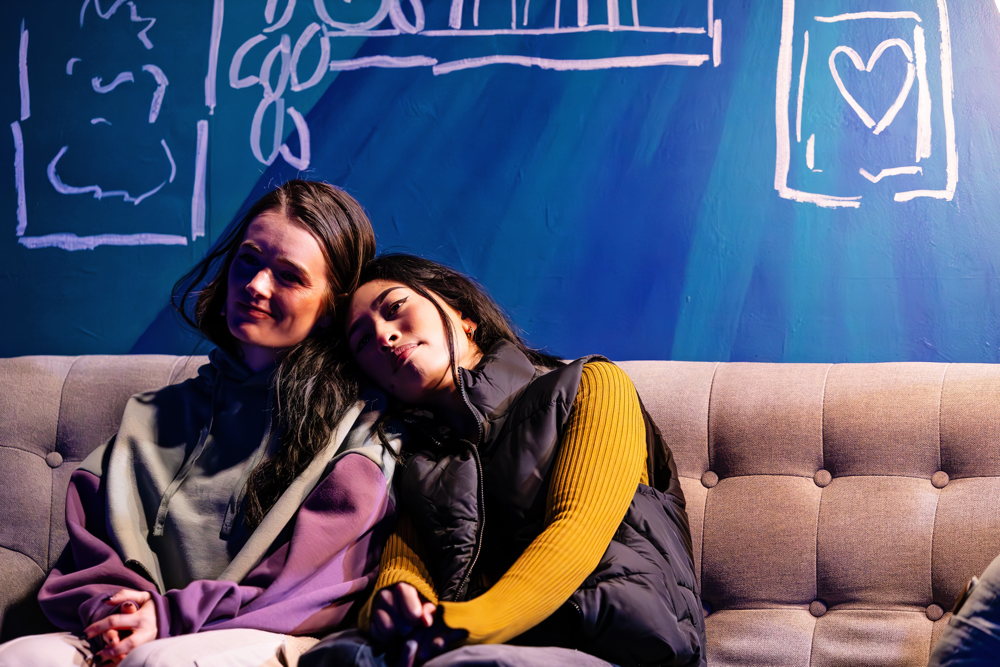
Photo by Time Stops Photography
Playwright Preston Max Allen states in the author bio for his musical Never Better, now playing at Theo, that he had to prioritize his own mental health when he put the script away in 2017 after working on it for three years. That thought—that we all should prioritize our own mental health—is, as it happens, at the core of this provocative musical work-in-progress. Many of the characters have learned or need to learn that message, very much akin to the standard flight attendant’s admonition to put on your own oxygen mask before tending to others.
Allen’s powerful and expressive music and lyrics are the omnipresent elements that connect us to the story, and music director/keyboardist Ellie Kahn’s excellent musicians here also are tasked with playing (sometimes key) roles as director Landree Fleming opens up the closed-off world of depression, loss, suicidal ideations, sexual violence, and terminal illness. Not for nothing does Eleanor Kahn’s (despite the similar name, she is not related to the aforementioned Ellie Kahn) set contain several glassed-off segments: these musicians/characters, like the play’s main character, wall themselves off from the world and the help they need in order to navigate the pain they are facing…which too often they choose to face alone.
Emma Samuelson plays Davy, a college art student who is trying to deal with her own troubled universe: when she was sixteen, her mother died of cancer and her father then married Mom’s best friend. Now she finds herself with all of the classic signs of leukemia at age 20 and willfully ignores them, preferring to face death rather than work on living in a world that has dealt her such cards. Davy’s best friend/roommate April (Melody Murray) is still working her way through her own teenage sexual assault trauma (mostly by making popular TikTok videos trying to help others in her position).
Both of these young actors give such open, raw performances that it is impossible not to identify with them. Samuelson is outstanding as the emotionally (and now physically) broken Davy. She is equally strong when she is not the focus as when she is: I don’t remember the last time I wanted to focus on the character who was not talking because an actor’s reactions were so dynamic, but I was doing it all night. (I may have missed a few powerfully expressive moments by her scene mates but that is more the result of a playing space that extends the length of the theatre and is impossible to take in fully without turning your head. It is a very unusual setup for Theo, which is usually configured with its stage at one of this production’s side walls. It is a fine idea if you don’t count the pain in my neck muscles.)
As for Murray, she can and does hold her own against anyone’s performance. As Act Two begins, we watch her give a powerful, unfiltered monologue in which she explains that she must face the impending release of her attacker, who has never admitted his guilt but somehow convinced the parole board anyway. It is a brilliant counterpoint to her earlier soliloquies at her makeup table and in her videos: the pain she is trying to hide in her career is forced to the front.
Davy is unable to hide her own pain (and her increasingly obvious illness) from her friend, but she refuses all offers of help. This is also true for her sort-of boyfriend (Shawn Smith as Carter, who wants to take things in a new direction but can’t get through Davy’s walls…and has no clue why). Smith is excellent and, through songs like “Rockstar” and “Perfect,” lets us into his not really very hidden desires.
Liz Bollar plays Aynsley, a Nurse Practioner whom Davy meets on the one day she does agree to go for tests and who finds it impossible to get the young woman with likely leukemia who utterly refuses to go in for confirmation of the diagnosis or begin any treatment out of her mind. Aynsley too has suffered a loss: her husband died a few years earlier, and she is in no way over it. (She tells Davy that you don’t ever get over it; you learn to live with it.) Bollar’s big, expressive voice leaves no doubt of her pain in songs like “Valentine” and “Erase.”
Though the musicians all enter the fray as minor characters at some point, the most powerful performances are those of Ismael García and Travis Shanahan as a woman and her terminally ill partner who has decided to drop out of her life to save her pain. He is easily comparable to Davy: neither wants to deal with their illness and both have no clue what their recalcitrance is doing to their loved ones.
Never Better probably could use further development. It starts to feel a little bit repetitive in the first act, for example, and it is a bit hard to believe that Davy could remain a student at the university if her depression doesn’t allow her even to go to classes. It also could have used at least one scene with April and Carter together trying to figure out how to deal with her. (As it is, we jump directly from a scene with April worried that sweet, gentle Carter is causing Davy’s bruises to one in which she tenderly refers to his deep affection for her friend: huh?) But writer Allen simply could not have asked for better performances to convey his characters and ideas, and his songs, both the rocking ones and the more contemplative ones, are handled brilliantly. And director Fleming has her actors working at consistently high levels throughout.
This is another in Theo’s new commitment to producing unseen, original works still in development. Last year brought us the memorable Baked, and this year’s show takes us in a very different direction, but it is going to be haunting me for a long time. I’ve long dealt with depression in my own life, and it also runs in my family. This play feels realistic and honest as it portrays mental illness. I’m profoundly grateful that I saw it.
Never Better is now playing at Theo Ubique, 721 Howard Street, until Oct 13. Tickets are available at theo-u.com. For more Chicago reviews or show information, see chicagoonstage.com or theatreinchicago.com.