
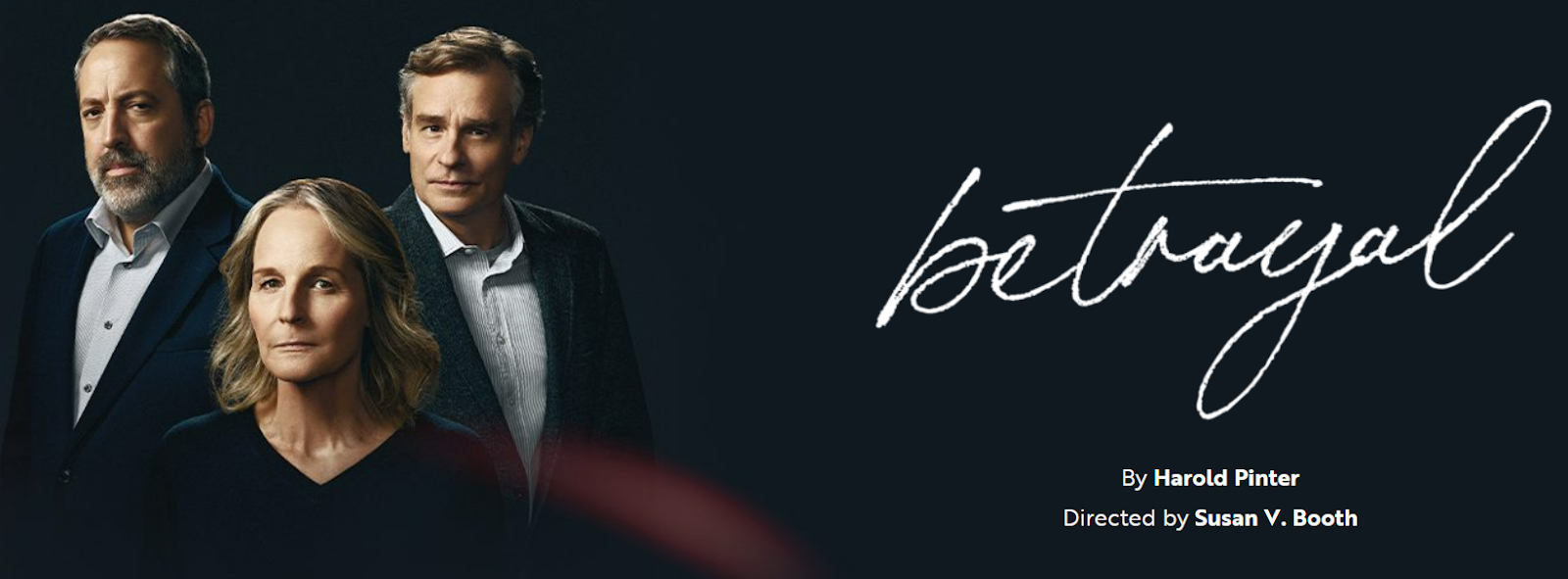
Harold Pinter has been described by many as one of the most influential British playwrights of the 20th Century. Known for his mastery of subtext and the iconic “Pinter pause,” Pinter’s exploration of fractured relationships is on full display in this reverse-chronology narrative. Betrayal dissects the unraveling of two relationships- a marriage and the affair that ended the marriage- by peeling back layers of deception in a non-linear structure that challenges the audience to consider who is betraying who?
Such a complicated show can best be told by actors of the highest caliber, and director Susan V. Booth brought together a formidable cast whose resumes include Oscar and Tony wins and nominations. This trio, under Booth’s skillful direction, delivers performances that capture the depth, complexity, and subtle emotional shifts in Pinter’s characters.
Robert Sean Leonard, as Jerry, the lover, is both captivating and persuasive. The audience watches Jerry from his unraveled end as he re-ravels backward into the man willing to make bold choices to uphold his love affair with Emma. Leonard creates a character both believable and sympathetic until the very end/beginning when in true Pinter style the audience is left to wonder what brought him there in the first place.
Ian Bradford’s Robert, the husband, is the most interesting character of the three. Bradford seems to have the most moments of Pinter pauses. Harold Pinter used these pauses because, as described in an article in the London Theatre Direct, “Often when we search for the right words, we pause. And sometimes, we have no comment at all, remaining completely silent.” Bradford harnesses these moments, using them to deepen Robert’s internal conflict, compelling the audience to ponder how much he knew, when he knew it, and, more importantly, why he chose to stay.
Helen Hunt’s Emma is the character that presented the biggest enigma for me- and what could be more Pinter than that? At first glance, Hunt’s Emma appears detached, her agency seemingly diminished as events unfold around her. Her restrained performance, distant and often emotionless, reflects Pinter’s nuanced framing of women. Yet, as the narrative rewinds to its origin, it becomes evident that perhaps Emma holds the greatest power—she dictates the beginnings and endings of each relationship. Ultimately, perhaps Hunt’s portrayal of a cold and distant Emma is not because she lacked agency but because in fact, she was controlling the story in a way that women in the 70’s were finally able to do.
Classic Goodman style means, of course, a set that is a crucial part of the story. Neil Patel utilizes a minimalist set with two orange ’70s armchairs, a round table, and wooden chairs used to set us in a variety of places. What is striking, however, is the shadow of the ever-present bedroom center stage throughout the production. While only used in one pivotal scene, its presence reminds us that in this stark, dialogue-heavy play, it is really what is happening in that room that is at the heart of all that is unfolding.
Betrayal and the Pinter style may not be for everyone- after all, it is very British and neither the actors nor most people in the audience (I would assume) are. However, one can never go wrong spending an afternoon or evening at the Goodman Theatre in the glow of such powerful performers.
Betrayal is now playing at the Goodman Theatre, 170 N. Dearborn Street, Chicago, through March 30. Performance times vary; check the website at Goodman Theatre. Find more information about current plays on our Current Shows page and at theatreinchicago.com.