
Wannabe Studio Photo
I remember baseball cards. I never collected them, but I did have some that I could call “mine.” In the 60s and 70s, boys (and some girls, and some boys who were really girls and girls who were really boys) would clip them onto bikes so that the spokes hitting them would sound like a childish approximation of the engine on a motorcycle. I knew that many boys collected and traded them, but I was too busy reading to get into that.
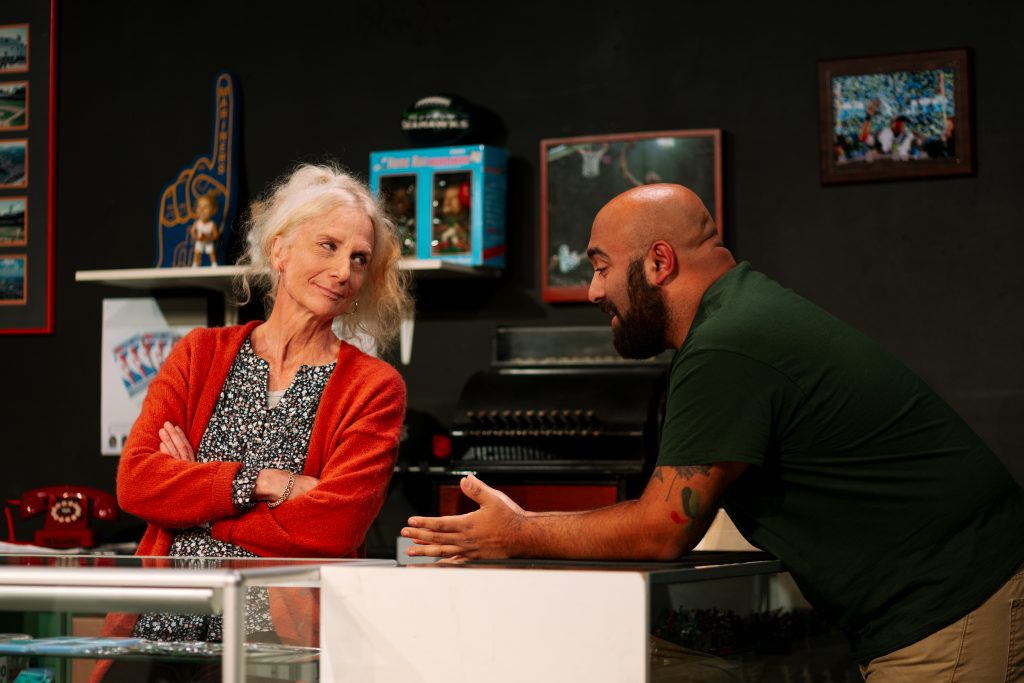
Thank goodness, playwright Zach Barr didn’t have quite such a misspent youth. Their new play, The Pilon, (currently in Red Theater’s world premiere production directed by Jessica Love) takes place in a card shop and takes us into the lives of five people who, to greater or lesser degrees, revolve around the world of what they refer to as “the hobby” even though they know that it has (to the chagrin of most of them) evolved into a business. “The Pilon” of the title is a basketball card, basketball having apparently supplanted baseball as the collectable card of choice over the decades, though the play also contains references to Pokemon and Magic the Gathering. It is an extremely rare (only seventeen copies were made and only a few remain unclaimed) rookie card of a Seattle Emeralds player who has shown the potential to become a superstar. (The card, potentially worth five figures, is of the highest current quality: more than just the simple cardboard of my youth, it shines and sparkles and even contains a tiny piece of one of Pilon’s basketball jerseys. No one would ever even think of putting it in bike spokes.)
All of this makes it the Pacific Northwest’s most sought after piece of sports memorabilia, so of course it will come into the possession of the denizens of Seattle’s Wax Harvest Card Shop, affecting their lives for the better or worst. Wax Harvest is owned by Rhonda, a trans woman played by Delia Kropp, and run by her nephew Corbin (Rio Soliz Ragazzone), a mostly low-key man whose greatest pleasure comes from a podcast he runs weekly from the shop. Its subject, of course, is cards; he opens packages on air and comments on what they contain, occasionally finding something important and valuable to his viewers. He is aided by Josh Rezavi’s Marc, a gruff, imposing man who, far more than any of the others, is into the business side of the cards. (Someone near me whispered “I don’t like him” to a friend late in Act One, and I had to agree; Rezavi does a brilliant job of making him unlikable.)
The other two characters are Lex and Griffey. Jordan Tannous’s performance as the openly gay Lex is—dare I say it?—fabulous. If it were not for Griffey, Lex would probably be the most sympathetic character of the bunch. He collects cards of all sorts—his pride and joy is a Shirley Temple card—and doesn’t care about any monetary value they might have. He just enjoys them. As for Griffey, a thirteen-year-old trans boy played by high school freshman Harper Levander, he collects because he loves basketball, especially the Emeralds (a fictional team that replaced the SuperSonics in the hearts of Seattle fans) whom he supports with all of the enthusiasm of a boy his age. He can’t afford more than one inexpensive pack a week, but he has fun buying it and hanging out in the shop.
When the prized Pilon card comes into the possession of one of these characters, all of them are forced to examine what to do with it, why they collect in the first place, and what this says about who they are and how they interact with the world. The fact that three of these people have had to publicly handle difficult sexual or gender issues shows that they understand and value their truths, but will the sudden appearance of a significant windfall change them? To their credit, Barr doesn’t fall into any of the tropes they might have about LGBTQIA+ people and their lives. Rhonda, Lex and Griffey are all basically happy people, and this is a love story at its heart: the love of parents and children, queer love, the love of a shared hobby, and the love of a discovered identity. As a trans woman myself, I was happy to note that, if the queer characters have been touched at all by the world’s unconscionable hatreds, only Rhonda briefly acknowledges it (and, like a concentration camp survivor, her problems are all long in the past, though they have affected her deeply). Both Lex and Griffey have secrets they keep to themselves, but neither of them is overtly about identity.
Director Love does a brilliant job of bringing these characters to life. I could well imagine her and her cast working hard on many of the interactions here as well as on finding the inner fears and joys that the Wax Harvest crew harbor. Her blocking—on a well-conceived set designed by Manual Ortiz and meticulously decorated by Chas Mathieu that places the audience in the shop—keeps what could easily have become an overly static production moving. She does have an unfortunate tendency to place young Levander in lengthy presentational positions that feel unnatural even in this thrust staging, but otherwise everything works perfectly, and she and the cast even keep long behind-the-counter segments amazingly alive.
All of the actors here are totally on their games. Kropp’s depiction of a highly maternal older trans woman, dispensing careful advice to just about all of the others despite Rhonda’s apparent desire to live quietly and (probably) leave this shop to Corbin when she is ready. Ragazzone is a lot of fun here, and not only in his manic podcasts; on at least two key occasions, Barr throws him curve balls (I know: wrong sport) that force him to deal with situations that Corbin does not expect at all. His facial work each time is truly a thing to behold. Rezavi has unexpected moments spanning the whole gamut from nearly violent anger to gentle love as his character too works hard to handle surprise revelations. Tannous probably could have played Lex as a complete stereotype—after all, Lex is extremely out and doesn’t hide anything about his sexuality—but he doesn’t: his Lex has so much depth and honest emotion that you can’t help falling a little bit in love with him, no matter where on the Kinsey scale you might fall. And as for Levander: from the first time we see Griffey sitting alone in an Emeralds jersey watching them on TV, there is something that feels almost…profound…about him. He’s a middle school kid with the strength to transition socially but struggling with the notion of manhood and exactly what it means. He tells his adult friends at the shop that his father (who always wanted a son) now spends all of their time together teaching him how to be a man, taking him fishing, knife-throwing (talk about stereotypes), and other “manly” activities of no interest to Griffey, who just wants to figure out what kind of man he will be by himself.
On opening night, small mishaps gave Levander and Kropp (the youngest and oldest in the cast) opportunities to practice their improvisational skills, and in this too they proved very adept. Not that this was at all surprising: this is a talented, well-prepared group, and with the significant number of twists in Barr’s humorous but sincere script, they were ready for anything. The Pilon is a joy, and I even learned quite a bit about card collection in the modern era…not that I’m all that likely to be able to use that knowledge. If you are going to see it, and you should if you enjoy, well-written, well-produced, well-acted, and wel-coming theatre, get tickets early, as The Edge Off Broadway is a very small house and this play is a little gem.
The Pilon is now playing at The Edge Off Broadway, 1133 W. Catalpa, through Nov 23. Check the website for specific dates, times, and tickets. Find more information about current plays in our front page recs and at theatreinchicago.com.