
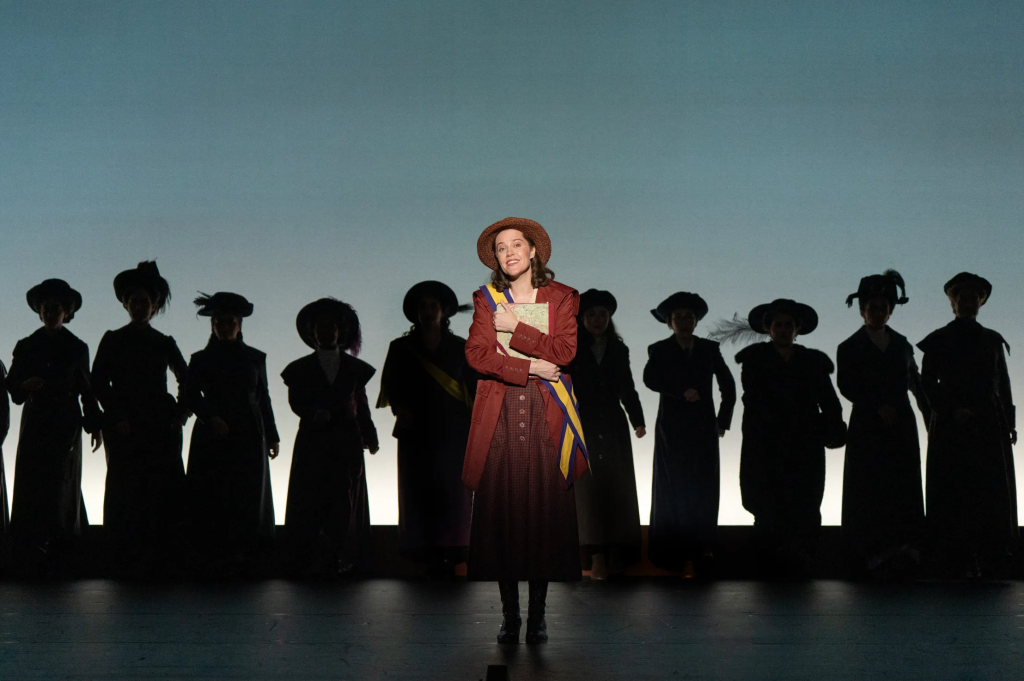
Photo credit: Joan Marcus
“We hold these truths to be self-evident that all men are created equal,”
For 144 years, those famous words from the Declaration of Independence quite literally applied only to men. Women would not gain the constitutional right to vote until the ratification of the Nineteenth Amendment in 1920, thanks to generations of determined suffragists (and yes, I learned from this show not to call them suffragettes—a term many activists of the time considered dismissive). Suffs, Shaina Taub’s Tony Award-winning musical, tells the story of those women who refused to wait any longer.
Suffs focuses on the National Woman’s Party, led by the fearless Alice Paul (Maya Keleher), whose willingness to embrace more confrontational tactics put her at odds with Carrie Chapman Catt (Marya Grandy) and the more measured National American Woman Suffrage Association (NAWSA). Through marches, White House pickets, imprisonment, and hunger strikes, the women force the country to confront a question it had avoided for generations: how could we be a democracy when half the population had no voice.
My day job is teaching high school U.S. History, and this is one of my favorite stories to tell. My students laugh when I admit I have a favorite constitutional amendment- the Nineteenth, of course- and every year we watch Iron Jawed Angels, which tells much of the same story. That familiarity made seeing Suffs especially rewarding. I found myself constantly leaning over to whisper to my son, “That really happened,” only to have the cast break the fourth wall and beat me to it a moment later. Even better, Taub’s script introduced me to details I had never encountered before. For someone who thought she knew this chapter of history inside and out, this made the show even more memorable.
Taub’s score is almost entirely sung-through, allowing the production to cover years of history without ever losing momentum. The music isn’t always immediately memorable, but it is dramatically effective, carrying the audience through victories, setbacks, and ideological divides with remarkable energy. One of the production’s cleverest choices is casting women in every role, including Woodrow Wilson, played at this performance by swing Merrill Peiffer, whose comic timing drew some of the evening’s biggest laughs.
Vocally, the touring company is very strong and my son said some of the best acting he has seen. I have long said Alice Paul is my favorite American hero, and Maya Keleher captures the relentless determination that made her such an extraordinary leader. Paul’s brilliance was never simply her courage; it was her refusal to accept incremental progress when equality itself was at stake. Keleher conveys that unwavering conviction throughout the evening, culminating in a soulful rendition of “Worth It.”
Paul’s fellow suffragists are equally compelling. Monica Tulia Ramirez brings bombastic strength to Inez Milholland, the movement’s early public face and energy. Joyce Meimei Zheng’s Ruza Wenclawska, Livvy Marcus’s Doris Stevens, and Grynne Wood’s Lucy Burns each contribute distinct personalities and unwavering determination, illustrating that movements like this are never the work of one extraordinary leader alone.
One of the musical’s greatest strengths is its refusal to present the suffrage movement as uncomplicated. Through Ida B. Wells (Danyel Fulton) and Mary Church Terrell (Trisha Jeffrey), the show confronts the movement’s failures to fully embrace Black women and asks difficult questions about who gets left behind when social movements pursue political compromise. These moments add welcome complexity to what could otherwise become a straightforward historical celebration.
Grandy’s Carrie Chapman Catt is also compelling. She portrays a woman who shares Alice Paul’s ultimate goal but fears that Paul’s confrontational tactics could jeopardize decades of painstaking progress. Rather than making Catt an antagonist, Grandy allows us to understand the wisdom and limitations of her caution.
The only criticism I have of the show is that some of the musical’s most harrowing moments- the riots that break out at the parade and the picketing or the brutality faced when the suffragists are imprisoned- never fully land emotionally. While the production stages these moments with theatrical elegance, I never felt the full terror or sacrifice these women endured. Knowing the history, I wanted those moments to leave me more shaken than they ultimately did. And while I understood the ending- checking in on Alice in the 1970’s and showing how the woman’s movement still had and has work to do- I felt like it was a little contrived to end at this moment.
More than anything, Suffs reminded me why I love teaching this chapter of American history. It is the story of ordinary women accomplishing something extraordinary, often at tremendous personal cost. Whether you arrive knowing every twist and turn of the suffrage movement or very little at all, you are likely to leave with a deeper appreciation for the women who secured one of the most fundamental rights in our democracy. And the next time you cast a ballot, perhaps you’ll think of Alice Paul, Ida B. Wells, Carrie Chapman Catt, and the countless others who made that moment possible.
Suffs is now playing at the CIBC Theatre, 18 W Monroe, Chicago, now through July 19. Performance times vary; check the website at Broadway in Chicago. Find more information about current plays on our Current Shows page and at theatreinchicago.com.