
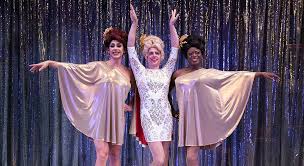

If it crossed your mind to think of it, one of the last places you’d expect to find a drag show would be Panama City, FL. It’s a small place with a deserved “redneck” reputation, and RuPaul doesn’t fit in with NASCAR and football and beer. But Northlight Theatre in Skokie puts a dive bar in Panama City onstage in its latest show, and drag is on the menu. Sometimes oil and water somehow do manage, for the most part, to blend together.
“The Legend of Georgia McBride” is an unabashedly silly show with a serious core. It’s difficult for it to be anything but silly when its story focuses on a down-and-out Elvis impersonator who, through a series of flukes, finds himself drafted into becoming a performer in the aforementioned drag show. And he is straight. Married, expecting a baby, too embarrassed to tell his wife what he is now doing so he’ll make up a lie straight.
This fish out of water story doesn’t necessarily offer many major surprises, and that is one of the drawbacks of this play. Casey (Nate Santana), the Elvis impersonator/drag star who becomes the Georgia McBride of the title, is a truly likable guy who is caught between a rock and a hard place and is doing what he needs to do to get by, but when he lies to his wife you know that is eventually coming back to haunt him, and of course it does. What does surprise him is just how much he grows to enjoy this odd life. Watching him grow into it, though, we are far less surprised.
The drag show “belongs” to Miss Tracy Mills (Sean Blake), cousin to bar owner Eddie (Keith Kupferer) and a pure drag queen. That is to say, “Tracy” lives 100% female while in costume, but at home removes the makeup and the clothing and settles into a normal gay life. (Because 95% of the time in the play we see Tracy as female, I will use she/her/hers pronouns to refer to her throughout this review.) When she brings her show to Cleo’s, the little bar is going broke. It doesn’t take long, though, for something about the silliness and lewdness of drag to gain a following that shocks Eddie, and gradually the little dive becomes a glorious showplace. (What a shock!)

What doesn’t change is Casey’s apartment back home. His marriage can be too cute for words, but wife Jo (Leslie Ann Shepard, switching smoothly from sweetness to irritability to concern to frustration, sometimes all in one scene) is too upset over finances to keep the cuteness going for long. She is, though, the perfect yang to Casey’s yin: together they would make a great couple, as long as she could be around to keep his lack of foresight from destroying them. (They’re constantly late on bills, for example, and he spent part of the rent money on a pizza and a new Elvis costume just before losing his gig as an impersonator.) The apartment, described as a place “Ann Frank would have said hell no to,” is bedraggled and forlorn, making their inability to keep up with the rent all the more pathetic, and they own a car “held together by duct tape and optimism,” but they keep hoping that somehow their love will see them through.
Until Jo finds out she’s pregnant. Time to grow up. But not even being best friends with the landlord is helping them this time. The only positive thing they get from that is best wishes on the pregnancy. (“Kids are awesome,” he tells them. “I love both of mine.” “You have three,” Casey reminds him. “I know.”)
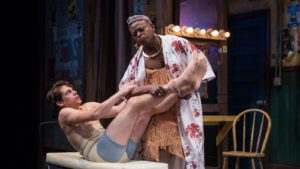
Santana is perfectly cast. I would have appreciated more effort to hide his facial hair growth while he was in drag (since he was supposed to be so good and so pretty, it was a bit hard to reconcile), and throughout the show, as he allegedly is getting better and better, though his energy and enthusiasm are contagious, his appearance never gets any more feminine. (This makes Jo’s late comment that he is “prettier” than she is a bit farcical.) Still the dance scenes are great. Doing numbers from performers as varied as Edith Piaf and Shania Twain, Santana (in skimpier and skimpier costumes) scampers and dashes and prances his way across the stage, having a grand time. Blake, too, is outstanding. An award-winning actor, he dives into his role, utterly vanishing into Miss Tracy until it is impossible to see a man there at all. If Casey has to learn drag from scratch from someone, Blake makes it entirely conceivable that Miss Tracy would be the one. But nothing in the staging allows either of them time to show anything but the most casual relationship with makeup.
Blake is also capable of turning his hospitality right off when the moment desires it, as we see several times when Miss Tracy’s show is threatened. But for a show that thrives on loudness and visual extravaganza, it is two very quiet moments that define it. One involves Blake, makeup off, explaining to Casey, now in a fight with Jo, why
You cannot move through life being good at cleaning up your messes. You need to make fewer messes.

The second follows that, with Casey singing to the club crowd most sincerely, in drag but not as a drag star, a song of his own invention: simple, raw, just him and a guitar. “What you get is what you see,” he sings, and we know it is true.
The other two cast members have wonderful moments in their own right. I’ve already mentioned Kupferer, whose gruff persona masks a playfulness that pops up in various places, mostly through physical schtick. Jeff Kurysz, as both Jason, the friend/landlord, and “Miss Anorexia Nervosa (Rexy),” shows off his range from calm, gentle friend to loud, brash, (mostly drunk) Latino drag queen. Rexy is by far the showier role, but once again it is as Jason, in a quiet moment, that Kurysz has one of the show’s best message lines. Speaking about an affair he had once with a TG woman, he says, “maybe the heart wants what the heart wants, and I was thinking with the wrong organ.” Not an original sentiment, but in an era when trans people are getting the short end of the stick even by the government in Washington, perhaps one worth considering. If “what we get is what we see,” then what’s the difference what lies beneath? We are all still the same people.
The Legend of Georgia McBride is a play about drag queens. But somewhere in there it is also a play about life and how we live it. And it may not be perfect but it does happen to be wildly entertaining. The night I was there the crowd laughed extensively and left talking enthusiastically about the show. We critics can get picky, but the bottom line is that that is what it’s all about.
chicagodramagirl
The Legend of Georgia McBride is playing at Northlight Theatre in Skokie through Oct.22. Tickets ($30-76) are available at www.northlight.org