


Early in Act Two of The Civility of Albert Cashier, the title character asks, “Is it better to live safe and sound but never live in peace?” By this point in the play, the audience already knows the answer to that question, which is a testimony to the quality of both the writing and the performers of this powerful, original piece of theatre. This is a play that is only in its first run ever, so it can be excused perhaps for some missteps, but even so it is an emotional and poignant exploration of an important issue. When it works, it works beautifully, and it works far more than it doesn’t.
The story of Albert Cashier is based on a true one: an Illinois soldier who fought bravely in the Civil War and, sixty years afterwards, was discovered to be a trans person by the medical staff of a soldier’s home (though that word, of course, did not yet exist). This resulted in a trial for “impersonating a soldier” and illicitly receiving a government pension. Cashier, who lived his entire adult life as a man, fought the charge, and it is the juxtaposition of these later events in his life with his enlistment and fighting in the war itself that forms the core of the play. We watch three wars taking place. In his mind, old Albert is still fighting the war, which we see playing out in his memories. In reality, he is fighting and losing two very different ones: the war against the government that can’t keep its nose out of his business and the very private war against the onset of dementia.

As Albert, both Dani Shay (young) and Katherine Condit (old) shine. Shay, a non-binary trans performer playing known more as a singer than an actor, gives a remarkable performance, showing us a determined and focused character who wants nothing more than to be a man and fight in the war for his country. (I feel as if I’ve just described Mulan, but the difference is that, while Mulan was absolutely female all the while, Cashier sees his gender identity as 100% male.) We see scenes of him bonding with his fellow soldiers, who at first are put off by his slight size but come to respect his bravery in action as well as his sincerity. Shay is an engaging and powerful performer with a truly dynamic voice, as comfortable belting as he is going nearly silent. He uses this latter dynamic at the start, in a song called “Ghost Boy,” when he quietly reveals important truths about himself:
I am a self-made man, born with my own two hands…I walk down the streets, nobody knows my name. She is everywhere.
By the time the war comes, though, he is feeling much stronger. In one of the musical’s signature songs, “Bullet in a Gun,” Shay as Cashier slides from calm to belting throughout and then to near silence to explain,
Say what you think of me, I’m opportunity. I’m strength, potential; I’m the gust of wind in a stormy sea. Something small, unknown, not dangerous on my own, but look for me when the battle’s won…

While Shay is having fun discovering Albert’s “potential,” Condit is busy in the Woodrow Wilson era trying desperately to prevent everything from unraveling. Once again battling an enemy in gray, he fights off the entreaties of the ward nurse (Delia Kropp, a gifted transgender actress). Nurse Smith, in a gray dress, is so easy to hate you’d think she was Nurse Ratched, which may seem to some as too facile a choice. It might have been, too, but for a scene later on in which the nurse, thinking to do some good, shows a gentler, more decent side to her charge, whom she finally believes she understands. Imagining Ratched in this scene pretty much short-circuits the brain. She may be evil within the story’s scope, but we see signs that she is at least capable of being something else too: a decent nurse. However, with her too-sleazy Southern orderly (Joe, played by Jordan Dell Harris, whom Albert constantly berates for being on the losing side of the Civil War), she plays out one final scene in which the evil nurse gimmick goes too far, and the creative team of the show may wish to rethink this one. Otherwise, though, Condit’s sometimes comical efforts to keep these enemies away keep the proceedings light as long as possible.
Condit’s vocal power, honed in shows on Broadway, in Vienna, the Goodman, etc.—she has all of the acting credentials her younger counterpart doesn’t—is easily a match for Shay’s, and she is brilliant singing the song that asks the question underlying the entire play, “What Is Real?” Albert’s whole life has been based on the persona he created after arriving from Ireland; how real is it? Though there may be moments when that question troubles Old Albert, Condit still shows the joy and thrill he gets with simple affirmations of his preferred gender. In an argument with Joe, he finds himself called both a “bastard” and an “old man.” “Old Man Bastard!” he exclaims, stating how much he likes that and confounding Joe, who of course was insulting him. Both the pain and joys of being Albert Cashier as a feeble, deteriorating 79-year-old come alive on Condit’s expressive face.
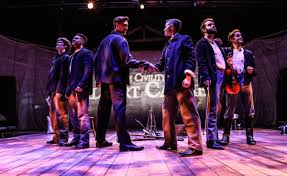
The rest of the cast is just as strong as the leads. As Jeffrey N. (don’t call him Jefferson) Davis, Albert’s “possum” and best friend from the war, Billy Rude is immensely likable and brings a needed sense of balance to Shay’s intensity. Cameron Armstrong appears as a Freeman enlistee assigned as the company’s medic, giving a strong performance especially in a cooking scene with Shay and singing his song, “Following the Sound.” A second orderly, played by Jonathan Stombres, belts out a grand and glorious ode to the great city of Chicago, a gratuitous song but one that I personally loved. (If the show needs editing for time, though, it should be the first thing to go.) All of the members of the company join in for the brilliantly choreographed (by Derek Van Barham) “Brothers in Arms” and Keaton Wooden’s direction keeps every scene looking fresh.
Even the set design is perfect in its pure simplicity. A long, wide stage made of uneven boards, several randomly nailed planks along the sides to indicate, possibly, a broken down shelter of some kind (like the stability and shelter of Cashier’s life is breaking down?), and huge drop to project war images onto. What more did set designer Jeremy Hollis and graphics designer G. Max Maxin IV need in order to give director Wooden something to play on? Nonetheless, even if it has some flaws that can be worked out in future revisions, this is a show that should not be missed, and it only has two weekends remaining. Its timeliness—its unfortunate relevance in today’s world—only increases the need for it to be seen, but see it because, if you don’t, you’ll be missing what surely will be one of the most remembered pieces of original Chicago theatre of the year.