
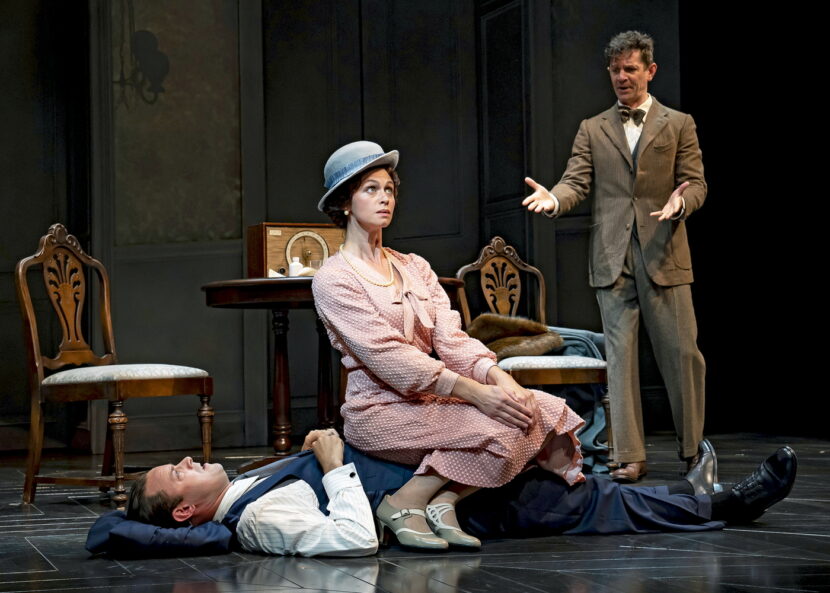
Review by Karen Topham, ChicagoOnstage, member American Theatre Critics Association. Photo by Liz Lauren.

By this time, we are more than used to seeing popular movies remade into plays and musicals. The King’s Speech, 2011 Academy Award winner for Best Picture, has taken a rather different journey to its current incarnation at Chicago Shakespeare Theatre. Playwright David Seidler originally conceived it as a play but rewrote it as a screenplay before he ever produced it on stage and then rewrote a stage version later that is now getting its American premiere. It was worth the wait. Under the direction of Michael Wilson, this play is completely engaging from start to finish even if you already know what happens, a fact that is fully attributable to the well-earned chemistry between stars Harry Hadden-Paton and James Frain.
As the titular stammering King, George VI, Hadden-Paton has perhaps the more complicated job: creating real emotional variety in a character whose very nature and upbringing teach him to remain outwardly stoic under all circumstances is a terrific challenge for an actor, and Hadden-Paton is superb. The first time we meet him, he is known as Albert, Duke of York (“Bertie” to family) and is listening to his father, King George V (John Judd), delivering a Christmas radio address to Great Britain. The usually quiet Albert waits until the event is over and he is left on his own and then tries to deliver the speech himself, revealing the extremity of his disability. His father, trying to force him to get past it, insists that he make an address at Wembley Stadium, which of course goes very poorly; however, it is there that his problem comes to the attention of Lionel Logue (Frain).
An aspiring actor and speech therapist from Australia, Logue has developed techniques that, he is sure, could help the Duke; still, he is caught off-guard when Albert’s wife, Duchess Elizabeth (an admirable turn by Rebecca Night), visits him to ask for his assistance. Elizabeth cares deeply for her husband; further, she is aware of the potentially very damaging relationship that Albert’s older brother, David, Prince of Wales, is having with a married American divorcée named Wallis Simpson, which may well thrust the shy Albert into the limelight. (David, as King Edward VIII, will in fact end up abdicating his crown in order to marry her.) Jeff Parker is strong as the self-absorbed Prince/King, a lifelong thorn in the side of his younger brother, whom he taunts as “B-B-B-Bertie.”
As Lionel—as he insists on being called by the Duke, whom he insists on calling “Bertie” despite protocol—and his new client work together, the Royal develops a grudging respect for the commoner’s abilities despite not fully believing that he will ever emerge on the other side of his speech problem. Watching the two actors work off of each other is a pure joy: each brings out the best in the other, and seeing Lionel attempt to engage “Bertie’s” well-hidden playful side makes for several wonderful sequences. Meanwhile, Lionel has to carefully navigate the churning waters of a marital disagreement with his wife Myrtle (Elizabeth Lido), who desperately wants the couple to return to their native Perth.
Lionel’s marriage is not the only issue facing his work with the future King. The Archbishop of Canterbury (Alan Mandell), in an effort to consolidate his own hold on power—he’d actually like to be the one running the whole country; a cleric in charge of a national government: what could go wrong?—seeks to undermine Albert’s relationship with Lionel while England and the whole world watch warily as the charismatic Adolph Hitler gains power in Germany and threatens another World War. The Archbishop and Winston Churchill (a brilliant performance by Kevin Gudahl) worry that Albert will never be able to become a King who can rally his nation to fight. Mandell makes for a fine, if rather artificial, “villain” in this piece; the cleric’s claim to govern is undefined and doesn’t pass logical muster, but he does manage to cause a rift between Lionel and Albert. Another potential troublemaker is the arrogant former King Edward, who keeps himself in the limelight so he will be in a position to “rescue” his country if his younger brother falters.
The King’s Speech is ultimately, like Pygmalion, a play about a transformation helped by an unconventional teacher. But while Henry Higgins takes on the task of changing Eliza Doolittle as a kind of challenge to his own genius, Lionel is coming to the aid of a man whose public position in the age of mass communication utterly demands it. Radio has altered the role of the King by making him far more accessible to the citizens of Great Britain than ever before; Lionel even refers to him as just a different kind of actor needing to be able to play his part well. The bond that grows between these two men, which ultimately transcends their sharp differences in station and class as well as the machinations of others and creates real trust between them, is more than a wonderful historical footnote. It is the key relationship that solidified King George VI’s leadership at a time of political upheaval both domestic and foreign and allowed England to become a leader in the fight against the Nazis.
Wilson’s direction allows for scenes taking place in the huge spaces of Buckingham Palace (a nice set designed by Kevin Depinet) to become as intimate as those taking place in Lionel’s office. Depinet’s design celebrates Albert’s position in the annals of British royal history by making use of the paintings of various monarchs: a nice design touch. Howell Binkley’s lighting and Hana Kim’s projections transform the set for different scenes, and John Gromada’s sound design provides authenticity to the radio speeches and helps transform the set into places like Wembley Stadium.
Fans of the film or Netflix’s The Crown (or in general anything having to do with royalty) will definitely want to see The King’s Speech, but it should also appeal to anyone who appreciates a meticulously crafted and directed play with many excellent performances. It’s not a bombastic or explosive evening, but with its quiet and dignified manner it is certainly a fine start to another season at Chicago Shakespeare Theatre. It fits nicely alongside the Bard’s history plays as a solid account of an important moment in the monarchy.
The King’s Speech is now playing at the Chicago Shakespeare Theatre, Navy Pier, Chicago through Oct 20. Check the website for specific dates, times, and tickets. Find more information about current plays in our front page recs and at theatreinchicago.com.