
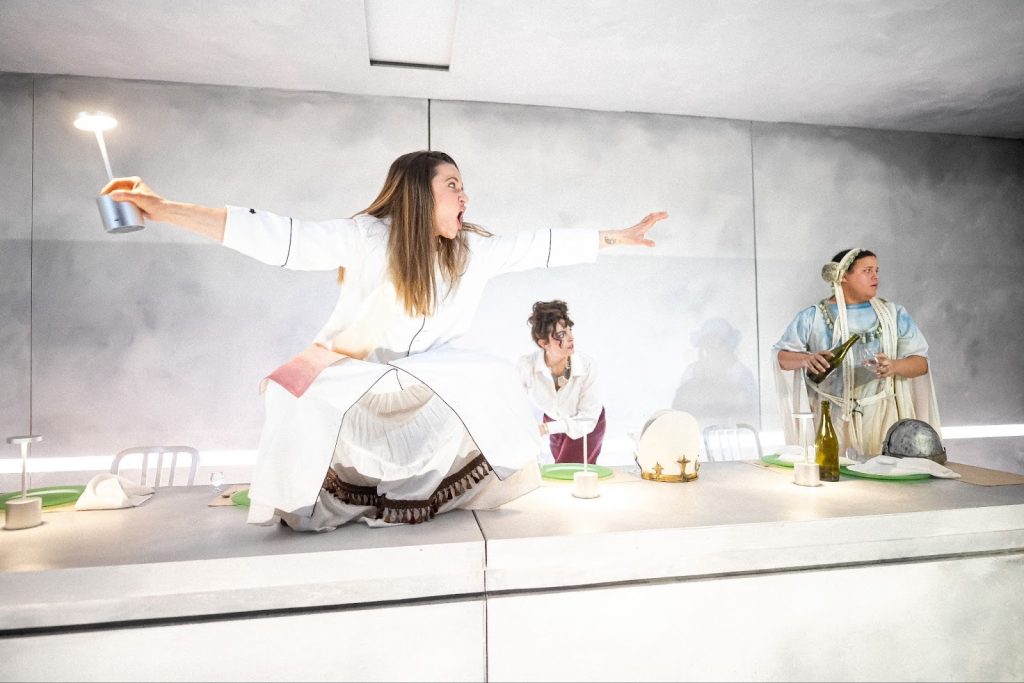
Morgan Lavenstein, Claire Kaplan, and Luke Halpern in Top Girls. Photo by Joe Mazza.
One of the best explorations of the theatregoing experience is the book Great Reckonings in Little Rooms by Bert O. States. It explores the way theatre has the power to affect an audience . Chicago audiences are lucky to have a chance to experience two great reckonings in two little rooms right now at the Raven Theatre: a revival of Caryl Churchill’s Top Girls, along with Pot Girls, a new riff on that play.
To begin, Raven Theatre’s astonishing reimagining — that’s the term the company uses to describe the production, quite appropriately — of Caryl Churchill’s Top Girls is, simply put, one of the most transcendent experiences I’ve had in a theatre in this or any other city. Though the play is more than 40 years old now, the cast and crew dig into the piece to make a thrilling piece of theatre that is wrenching, unsettling, and sickeningly timely.
Any discussion of Top Girls will start by remarking on the play’s unconventional structure. The first act is a fantasy/dream sequence in which the protagonist, Marlene (Claire Kaplan), hosts a dinner to celebrate her upcoming promotion to the managing directorship of the titular employment agency. Her guests are five women taken from history and folklore: the explorer Isabella Bird (Susaan Jamshidi), the possibly mythical medieval Pope Joan (Morgan Lavenstein), the 13th-century Japanese concubine and writer Lady Nijo (Hannah Kato), the European folklore character Patient Griselda (Luke Halpern), and Dull Gret (Yourtana Sulaiman), a woman from Flemish legend who led an attack on hell in a painting by Pieter Bruegel the Elder. Over the course of their meal, the women discuss their lives and the challenges they faced, aided by more than a few bottles of wine.
The play throws a lot at the audience very quickly, and it’s easy for this show to be too talky and static or, on the other end, overwhelming and manic. Director Lucky Stiff leads the skilled cast as a master conductor coaches an orchestra. At times, the dialogue overlaps and the pace becomes frenetic, and we get a real sense of joy that this is a space where these women feel free of social constraints. At others, Stiff and the cast will focus our attention on a particular moment to give it more emotional heft. These all concatenate to show that, real or fictional, across historical and cultural lines, all these women’s lives were shaped, constrained, and controlled by patriarchy. No wonder, then, that they’re so happy for Marlene’s achievement.
As the act builds to a climax, the group’s dinner party turns from celebration into cataclysm. Gret, having been mostly silent, finally explodes into a monologue about how the rage of living in a man’s world drove her to invade hell. During this speech, as Joan vomits into one of the wine buckets and Lady Nijo has an emotional breakdown, Marlene makes a discovery that shocks her, ending the act with a look of abject horror on her face. The moment’s full meaning is opaque at this juncture, and I won’t spoil it, but it’s central to making the first act work as a frame for the remaining two. It’s a subtle but extremely effective directorial intervention that’s a testament to Stiff’s brilliant interpretation of Churchill’s text.
The payoff comes in the final act as Marlene visits Joyce and Angie when we realize why the discovery horrified Marlene so. The scene is also an absolute masterclass in acting with Kaplan and Jamshidi dueling one another like prizefighters. It’s the kind of thing that’s impossible to fully describe in language but that will remind you why Chicago storefront theatres have a reputation for powerful, explosive performances. The play’s ending, a devastating revelation, is stunning, eliciting audible gasps the night I saw it. Compare it to the text on the page to get a sense of how a group of artists can bring language to life onstage.
Throughout, the cast nails the stylistic shifts that make the play so powerful. Kato and Halpern effortlessly transition from their historical personas into the careerist office types they embody in the workplace comedy of the second act. Kato makes a meal out of a monologue she delivers to Angie relating her career and life story to the younger woman that could easily become inert, and Halpern’s interview scene with Collin Quinn Rice’s Shona is riotously funny.
The cast also makes the most of another of the play’s opportunities in the role doubling. For instance, Lavenstein brings Pope Joan to life with a blustering grandiosity that collapses into heartbreak as she explains to the women what happened when she gave birth. This rhymes with her later performance as Louise, a woman seeking a new job through Top Girls because her work has gone underappreciated in her current role.
Likewise, Sulaiman’s delivery of Dull Gret’s monologue about attacking hell lies somewhere between triumphant and rabid as she strides across the restaurant table like a conquering hero. When she returns as Angie, we see the same frustration, anger, and potential for violence in the younger woman. This fractiousness makes the vulnerability that she achieves as Angie all the more affecting and Marlene’s betrayal even more profound. These kinds of juxtapositions, moving from riotously funny to wrenchingly sad on a dime, allow the play to affect the audience in multiple registers.
Scenic designer Joonhee Park’s set evokes a sleek, ultramodern restaurant and office, but its marbled interior is also cold and sepulchral. The ornate trappings of the modern office might as well be a tomb. The walls are actually screens so that when lighting designer Ben Carne illuminates them brightly, we can see the performers behind them in tableau. Stiff uses this technique to give the space additional depth and more opportunities for visual storytelling.
Through the costume design (big hair, shoulder pads, polyester) and soundscape (Depeche Mode playing on cassettes), we’re firmly grounded in the play’s 1980s milieu. These historicizing touches nod to Churchill’s dramaturgical use of Brechtian aesthetics, allowing the audience to draw parallels between the world of the play and today’s social problems. In total, the mixture of sharp directorial vision, deep understanding of what makes this play work, and a powerful, explosive, uniquely Chicago cast makes this an absolute can’t-miss show.
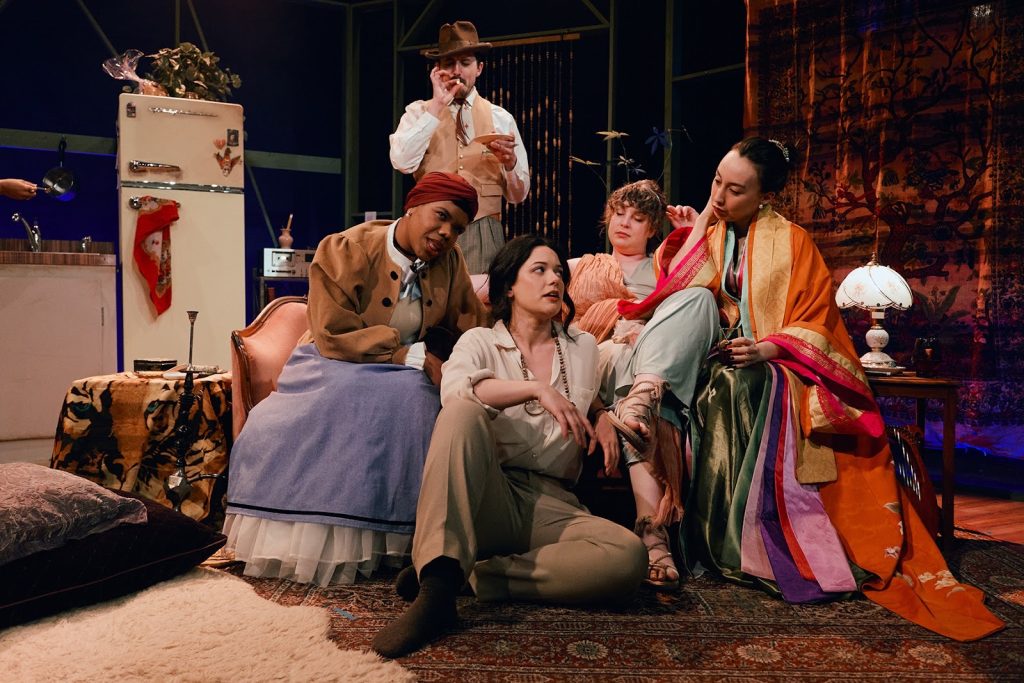
Myah Bridgewater, Peter Ferneding, Brenna Distasio, Tamsen Glaser, and Emily Marso in Pot Girls. Photo by David Hagen.
In the other Raven space is Pot Girls, a new play by Paul Michael Thomson produced by the Story Theatre. The company describes the piece as an “intertextual riff” on Top Girls, and it borrows that play’s structure. In the first scene, playwright Caryl (Brenna Distasio) and her lover (whom she often introduces as her roommate) Edith (Ireon Roach) host Caryl’s literary heroes Sappho (Tamsen Glaser); the Mexican-born nun and playwright Sor Juana Inés de la Cruz (Laney Rodriguez); British socialist, poet, and early gay rights activist Edward Carpenter (Peter Ferneding); Japanese novelist Lady Murasaki Shikibu (Emily Marso); and Phillis Wheatley (Myah Bridgewater), the first published African-American poet. As the play’s title suggests, the group smokes, snacks, and chats in celebration of the upcoming production of Caryl’s new play. Though they never explicitly say it’s Top Girls, that’s the implication.
The next two acts use the structure of a backstage drama in which Caryl fights to preserve her vision for the play amidst a host of challenges to raise large-scale philosophical questions about the purpose of art and the responsibility of the artist. The play’s director, Max, is a sexist creep (much as Max Stafford-Clark, director of the original Top Girls turned out to be). The American actress the company has hired wants Caryl to rewrite her role because she can’t learn the lines. It’s made clear to everyone that, should the play fail, the theatre won’t take another risk on a “woman’s play” again.
With the weight of her gender’s theatrical future on her shoulders, Caryl is forced to confront a moral dilemma. The company’s literary associate, Naomi, offers her a critique of the play’s racial politics and some suggestions for rewrites. In Naomi’s reading, given that people will read the play as a universal examination of women’s experiences, it needs to reckon with as many different kinds of women as possible. Caryl bristles at the note, though her anger may come as much from the realization that Naomi is right as the breach of professional etiquette. When Caryl refuses, Naomi threatens to have her wealthy father speak to his best friend, who also happens to be the play’s producer.
This conflict sets up the moral and philosophical arc that the play will trace. What responsibility does an artist have to incorporate valid criticism? What is the function and purpose of art? What lengths will someone go to to get what they want? The play is at its best and sharpest when the characters have these debates forcefully, and Thomson doesn’t allow for easy answers. The scene between Naomi and Caryl, echoed later by a similar fight between Caryl and Edith, is explosive and well-acted, and both scenes are excellent examples of the power of language to tell a story onstage.
Pot Girls is a clever play with snappy dialogue and well-drawn characters. It’s too long and sometimes feels more like a graduate seminar than a play (game recognize game), but Ayanna Bria Bakari’s direction is so fleet and graceful that it never really drags. The performances are sharp and funny — Marso’s self-involved American actor is a particular highlight — but something about the show didn’t quite cohere for me.
The problem is that the play is massively hamstrung by its intertextuality with Top Girls. In hewing so close to another play’s structure, Thomson forces himself to employ a form that isn’t necessarily the best one for the questions he wants to raise here. The smoke session at the beginning of the show is fun, but it doesn’t quite inform the rest of the play the way the first act of Churchill’s play does. You could cut it and the rest of the play would still work.
I also think Top Girls and Churchill aren’t particularly fertile territory for this kind of intertextual playmaking. Specifically, the play’s plot turns on Caryl committing a staggeringly immoral transgression to protect herself and her play. For a viewer familiar with the playwright and her work, it’s clear this is fictionalized. The Caryl of the play is from a working class family, didn’t get a formal education, and is a lesbian, all of which are untrue of Churchill herself. But it felt uncomfortable to me to suggest that a pathbreaking feminist playwright accomplished one of her landmark triumphs by literally selling a Black woman out to save herself.
To some extent, I do think Pot Girls is aware of this problem. Caryl herself asks why people are so much harder on her than Baraka’s extreme homophobia. That’s also not to say Top Girls or Churchill herself are beyond criticism. Marxist/materialist feminism, and Marxist theory more broadly, has received justifiable, necessary pushback for its often blinkered treatment of race and racism. Race and class are closely linked, especially in the United States, but they’re distinct phenomena that act along different axes. To wit, if everyone woke up tomorrow to find the American economy transformed into a Glorious Worker’s Paradise devoid of economic exploitation and inequality, do you believe racism would likewise vanish? Would misogyny?
In general, I think it’s poor criticism to try to fix a play or discuss what you wish had been in the work instead of what was there. (I imagine Thomson agrees with me because Caryl has at least two different rants about how dramaturgs are just failed playwrights in bad sweaters too cowardly to actually create anything for themselves. God knows what she’d have to say about critics). But Pot Girls actually offers a glimpse of a structure that might have worked better had it been applied differently. The play ends with a short coda in which Ferneding plays Thomson and directly addresses the audience. He cites Hortense Spillers and Toni Morrison, talking about why he writes plays and the problems he wants to confront. It’s extraordinarily earnest, but it is one of the few moments in the show that feels like it is defining itself on its own terms.
Some of the other cast members then appear, playing other members of the production team, and the final image is a group of them rewriting a line in the show until they get it right. I very badly wanted to see more of this throughout the play. Fracturing the narrative, injecting more authorial voice and commentary, and calling the audience’s attention to Pot Girls’ specific interventions and commentary on Top Girls would have, to my mind, made for a much more incisive piece of theatre that more clearly engaged with the source text. I found myself questioning why Thomson made these specific choices and too often felt adrift.
Top Girls’ structure (or that of Cloud 9 or The Skriker or Hamlet or Oklahoma! or any other play) is dictated by its content. “Content dictates form” is a cliche so worn now as to be nearly meaningless, but it became a cliche because it’s true. When a playwright cedes control of the play’s structure, they’re starting behind the eight ball.
Pot Girls is a worthwhile experiment and a good production by a strong company, but it’s hard to imagine it having the legacy of the play it’s engaging with. Seeing the plays in tandem only underscored that the relevance of Churchill’s play is perhaps greater now than at any other moment in its history. What Churchill saw in the rise of Thatcher, and what Top Girls warns about, is capitalist co-optation of surface-level feminist rhetoric without the crucial attendant commitment to a materialist politics and meaningful solidarity. Pot Girls revises and extends that warning. See both if you can, but if you can only see one, I’d take the Churchill.
Top Girls: Highly Recommended
Pot Girls: Somewhat Recommended
Top Girls plays at the Raven Theatre, 6157 N. Clark Street, through March 21 on Thursdays, Fridays and Saturdays at 7:30 pm and on Sundays at 3 pm.
Pot Girls plays at the Raven Theatre, 6157 N. Clark Street, through March 8 on Mondays, Thursdays, Fridays and Saturdays at 7:30 pm and on Sundays at 3 pm.
Both shows play in repertory on a Marathon Day on March 1 with snacks and a discussion between performances.
Tickets are available for both shows at raventheatre.com.