
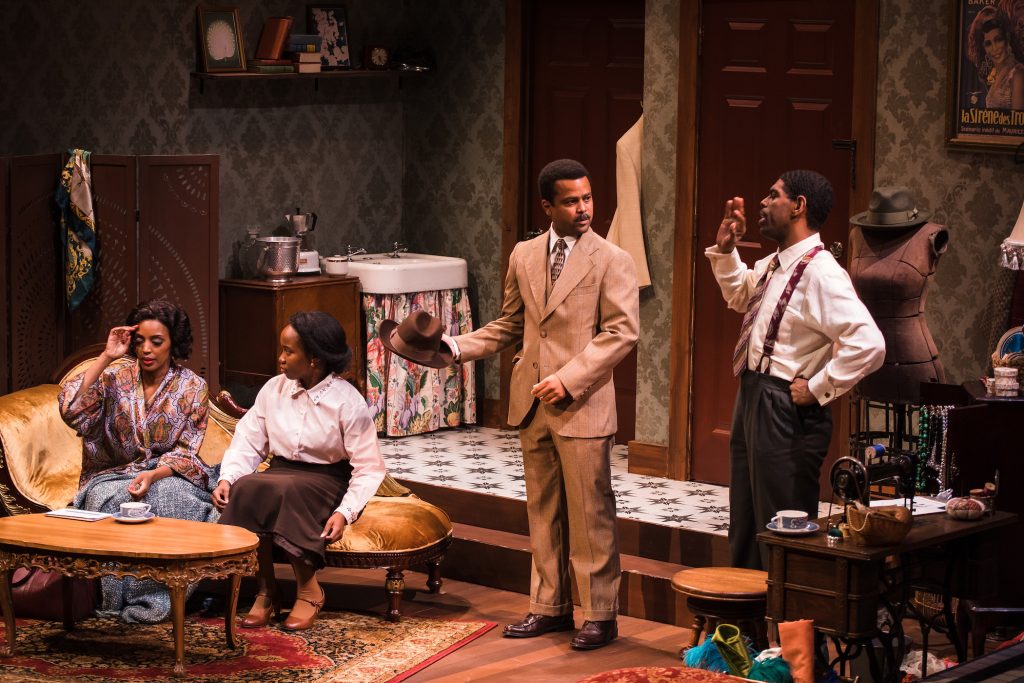
Photo by Nomee Photography
There are times for a director to put an imprint onto a script, but there are others when the play is just so rich and perfect that there is absolutely no need. Pearl Cleage’s Blues For an Alabama Sky, directed by Michael Burke, is one such play. Written in 1995 and set in 1930 Harlem, it focuses on the ways in which the Depression has affected what until then had been the area’s rich culture. Many references to actual historical figures of the time—Langston Hughes, Dorothy Sanger, Rev. Adam Powell, and Josephine Baker among them—help tie the fictional characters of the play to what was actually happening in that era, and the play utilizes that culture beautifully to show how society both changes and…doesn’t.
The main character here is Angel (Tiffany Renee Johnson), a blues singer who has, at the time we meet her, just been fired from the Cotton Club (and simultaneously by her sugar daddy, who is one of the head honchos of the club) and finds herself, with employment opportunities dwindling, desperately seeking a way both to stay alive and to keep singing. She lives with and is partially supported by her flamboyantly gay cousin Guy (Breon Arzell) in a nice little apartment, not knowing that he too was fired at the same time she was. (The beautiful set, designed by Lauren M. Nichols, also includes a neighboring apartment.) Guy is a dress designer, making costumes for drag queens and some minor shows to support himself while awaiting the fulfillment of his dream: to design for international star Baker in Paris. He is almost preternaturally optimistic, sincerely believing that this unlikely rise will occur, while Angel—burned too often by reality’s darker flavors—just tolerates what she sees as his fantasy.
In that neighboring apartment, we meet Delia, who goes by Deal and is played by Jazzlyn Luckett Aderele. In stark sartorial contrast to Guy and Angel, Delia always wears sedate, unadorned skirts and blouses that match her quiet personality. But Deal too has bold dreams: she wants to establish one of Sanger’s Planned Parenthood clinics in Harlem and to put it in Reverend Powell’s Abyssinian Church. A fourth character, Sam Thomas (Ajax Dontavius), is a doctor who delivers many babies in Harlem but also drinks hard at night. (It is he who is well-known among his friends for starting evenings with the phrase in the title of this review, “Let the good times roll.”) Being a well-known doctor in the neighborhood, though, he has also been called upon at times to perform safe but illegal abortions, and 1930s society’s uncomfortable relationship with both “homosexuals” and family planning becomes the critical element of the play (though there is also the happiness of a budding romance between Sam and Deal).
A fifth character, a migrant from Alabama named Leland and played by Edgar Sanchez, arrives on the scene as Guy is helping the extremely drunk Angel home on the night of her firing. Suddenly without a job or a man with the economic troubles of the Depression just beginning, she latches onto the good-looking Leland as a possible bridge to a future. This time, what she doesn’t know is that Leland is an old-fashioned fundamentalist who will need to be the one in charge of everything in any relationship and will keep her away from singing, clubbing, and gay people like Guy (whom he calls an “abomination). His arrival, unbalancing the lives of the other characters—which otherwise would be nicely broken up into Guy & Angel and Sam & Deal—is the key event that starts the plot’s inevitable unraveling.
Burke’s deft touch here is almost invisible, as befits the director of a realistic play. It shows itself in the carefully constructed characters and their onstage movements as well as in pacing and the overall style of the production, but he does not and need not seek to place his own imprimatur onto Cleage’s elegant narrative. His designers have shaped a lovely interpretation of the play’s world through this set, the lighting (Becca Jeffords), the costuming (Gregory Graham), the wigs (Ray Sanchez), and the sound (Peter Clare), and Burke makes it easy for his actors to inhabit it.
Blues for an Alabama Sky is an enormously powerful play because Cleage’s characters are so realistic and we know that the historical stakes for these people are high. They don’t really have a clear understanding of the dangers and difficulties they face, but we do. As another New York-based Depression-era play put it, this will be “a hard-knock life” no matter what they do, and there is not much they can do about it but sing the blues.
Blues for an Alabama Sky, a Remy Bumppo production, is playing at the Den Theatre, 1229 W. Belmont in Chicago through October 15. Performance times vary; check the Remy Bumppo website. Find more information about current plays on our Current Shows page and at theatreinchicago.com