
It begins with a question.
“We see what goes on in the world, don’t we?”
And in the lines that follow–the opening lines of Remember This: The Lesson of Jan Karski–we are called to listen, to remember, to act.
“Do we have a duty, a responsibility, as individuals… to do something, anything?”
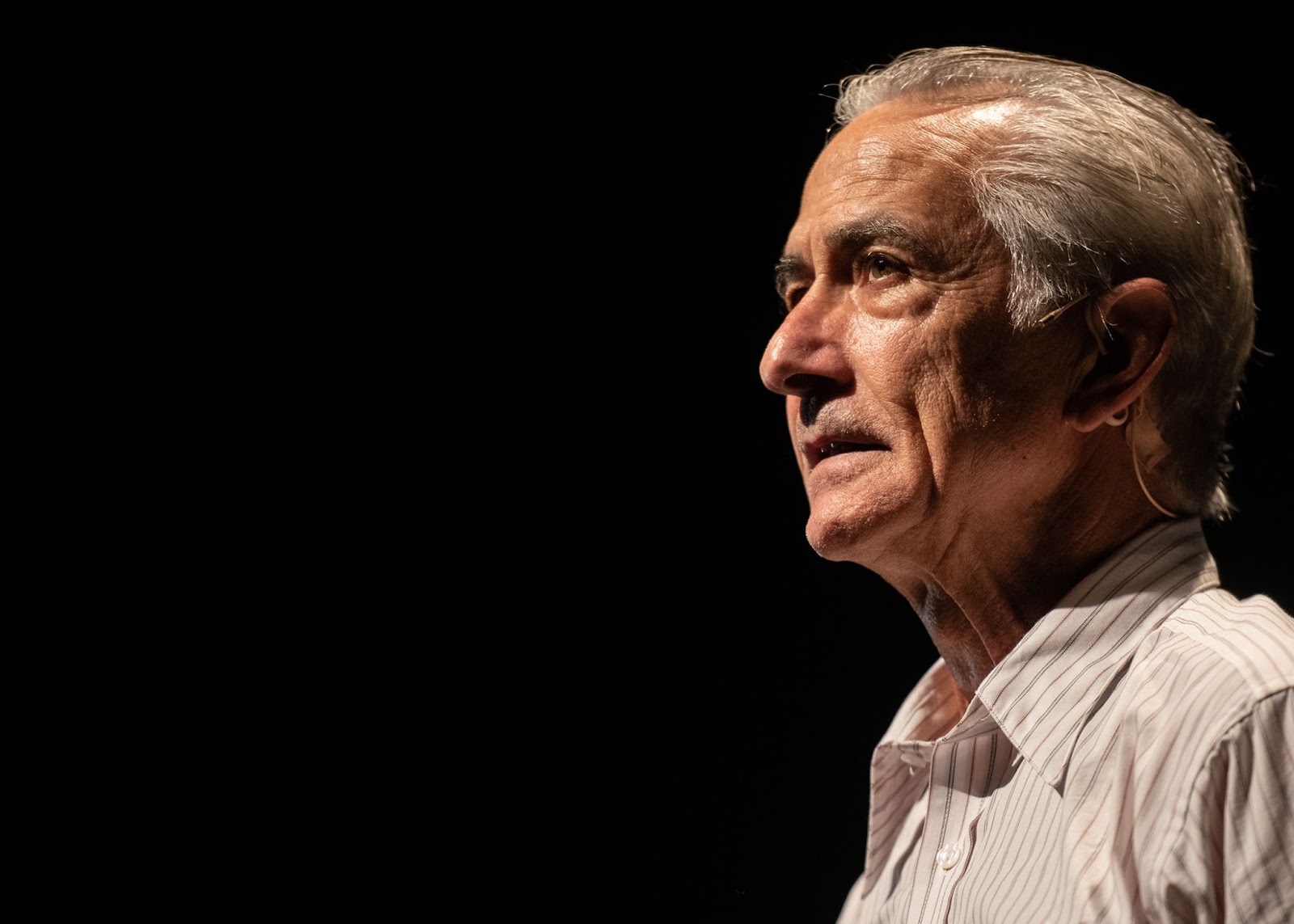
In his mesmerizing performance, the eminent David Strathairn channels the gravity of the millions of souls who might have been saved if only the world had acted on the message of a young Polish courier and diplomat, Jan Karski, a man who risked everything and somehow survived to deliver the message of the holocaust to Churchill and Roosevelt.
“We see this, don’t we? How can we not see this?”
Karski’s story is one of extraordinary courage and humanity. There were moments when he could have turned back. He might not have served in the army or joined the resistance. He might not have slipped away in the night. He might have shrunk from the beatings and told what he knew. He might not have kept going. No one would have blamed him.
No one could have imagined how far Jan Karski would go to deliver the message.
And when he finally arrived, when he finally was given the chance to tell those in power of the horrors of the Jewish Ghettos and the death camps… no one would listen.
“Human beings have the infinite capacity to ignore things that are not convenient.”
Karski delivered his report of German atrocities in Poland to British Foreign Secretary Anthony Eden and President Franklin D. Roosevelt in 1943, but neither Great Britain nor the United States took action. By the time the death camps were finally liberated in the course of the war, more than three million Polish Jews had been murdered, about half the total number of European Jews killed in the holocaust.
“The Jews were left alone to perish… It haunts me now, and I want it to be so.”
Written by Clark Young and Derek Goldman and produced by the Laboratory of Global Performance and Politics at Georgetown, Remember This tells the story of Jan Karski, a much-loved professor who–students were amazed to learn–was also a World War II survivor and spy for Polish Underground with an impossible story of survival and perseverance.
Strathairn–renowned for his roles Good Night and Good Luck, Nomadland, and Lincoln–opens a window into the professor’s soul as he delivers his most important lesson.
When Karski taught at Georgetown’s School of Foreign Service, he would often play the roles of the people he was describing. In an unforgettable, tour de force performance, Strathairn channels Karski playing the characters in his story–from family and friends to Soviet guards and the Gestapo, to Supreme Court Justice Felix Frankfurter, to F.D.R,–all in the voice of the professor.
Misha Kachman’s spare and effective set, Ivania Stack’s costumes, and Zach Blane’s inspired lighting design evoke the memory-like, classroom-esque feel of the production. “The word is mentioned twice in the play, the word ‘imagine’ and ‘imagination’,” said Strathairn when asked about the spare design and one-actor format in the Q&A session following the opening night performance. “And I think this format, this scenic design, challenges the imagination.” Playing Professor Karski in his element, Strathairn gives his audience of students the compelling and tragic lesson of a lifetime.
“Our greatest hope is that the four decades that Karski spent teaching and engaging students can serve as the catalyst for conversation for young people,” said Goldman, co-writer and director. “We see this very much as a current events play, not as a history play, as a play that’s meant to allow people to forge connections to what is happening in the world right this minute and especially for young people who may or may not know this history at all to find a connection to what they are grappling with… and for all of us, across generations, to remember.”
With Young and Goldman’s lean, powerful script, Karski’s harrowing story moves at a breathtaking–near exhausting–pace, which only further highlights Strathairn’s amazing depth and energy. His journey takes us from his home in Poland across the battle lines of the Nazi blitzkrieg and Soviet invasion, into the heart of the Polish resistance, to the depths of despair and degradation in the Jewish Ghetto, to the horrors of the Death Camp, to the halls of power in London and Washington D.C.
“I felt by doing this play,” said Strathairn, “and the response from the communities… that the play seems to be engendering is energy enough… there’s something that happens in the room, the electrons of communal sharing, that lifts me up.”
The result? Though this is a difficult play to watch, the story, the script, the design elements, and Strathairn’s inspired performance make it impossible to look away.
Through Strathairn’s eyes, we see the horrors of rising fascism, the brutal dehumanization and utter cruelty of the Nazi’s, the extraordinary heroism of those who fought to tell the world about the Holocaust while there was still a chance to do something to stop it, and the indifference of those who couldn’t or wouldn’t believe the truth. Delivered this way, Karski’s haunting lesson is unforgettable.
Strathairn holds a hero in front of us and demands we see him, demands we learn from his story, demands we hear the whispered words…
“Remember this… Remember this… Remember this…”
Remember This: The Lesson of Jan Karski is playing through November 14th at the Chicago Shakespeare Theater. Get your tickets at https://www.chicagoshakes.com.