
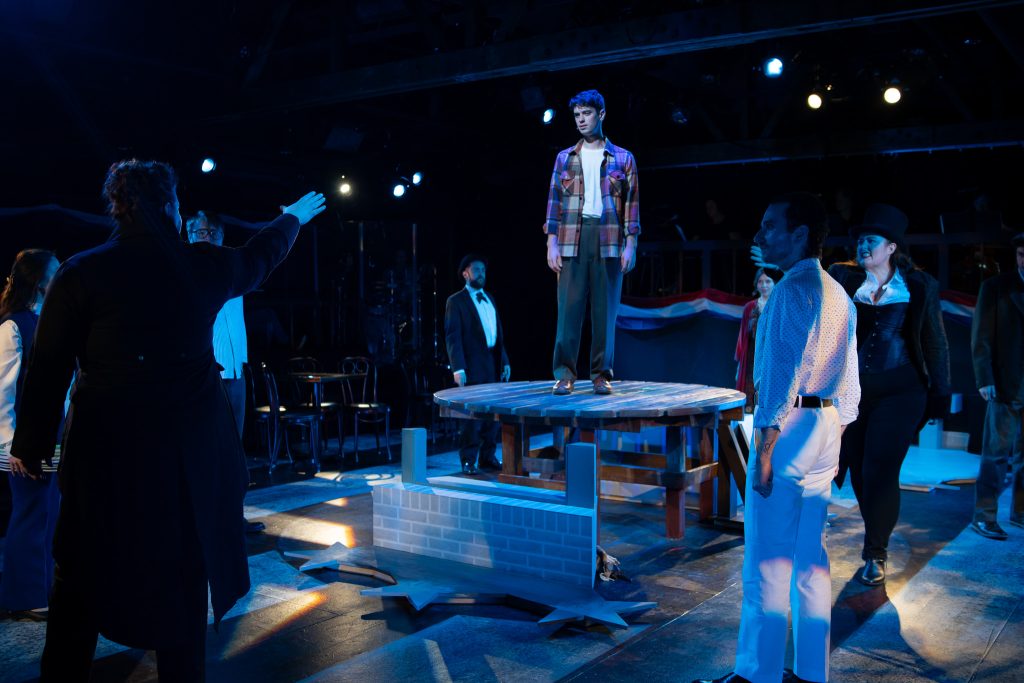
Photo by Elizabeth Stenholt Photography
I would say that Assassins is an atypical Sondheim play if I believed that there is such a thing as a “typical” Sondheim play. There isn’t, not when his subject matter moves from pointillistic painters to overlapping fairy tales to ancient Greek slaves to operatic unrequited love to romantic/pastoral comedy, but even against this backdrop, Assassins stands out. Who writes musicals about killers and would-be killers of US Presidents? And why? And how in the world could any playwright make such a musical entertaining?
Let’s get that last question out of the way immediately because the answer is both easy and obvious: if his name is Stephen Sondheim, the playwright can make anything entertaining. The man could always find ways of tapping into the zeitgeist using complex musical devices, utterly remarkable rhyming skill, and an unparalleled understanding of the sometimes absurd human animal. All of this is on display in Theo’s fun and fascinating exploration of what has been called “the dark side of the American dream.”
Theo (formerly Theo Ubique) is celebrating the late composer this year with two of his musicals and an original revue, and the Daryl D. Brooks-directed one-act is its season opener. Aided by Heidi Joosten (music director) and Grant Carriker (musical staging), Brooks allows his killers to take over the theatre (even the bar) as they subtly and not-so-subtly expose the way that such people manage to subvert the freedoms that they were given to destroy the very thing that made them able to destroy it.
John Weidman’s book shows us the grand parade of these “madmen” as they “had their say” in writing the history of the USA. His scenes take us from an imagined liminal space in which they are all gathered together to the moments of their brushes with infamy, sometimes combining the two in inventively surrealistic juxtaposition. And in an era when we have witnessed more than enough violence by madmen, sometimes egged on by self-important, self-justifying leaders who convince them of the justice of their actions, this play seems strangely (and sadly) more relevant than it ever has before.
In the opening number, the proprietor of a carnival game (Liz Bollar) offers the disaffected masses the chance to “come on and kill a President,” which she claims can resolve everything from political anger to poor book sales to unrequited love to terrible heartburn. Her examples relate to actual reasons for American assassination attempts; Sondheim doesn’t call these people “madmen” for no reason. In fact, “unrequited love” is actually the motivation behind two different attempts! It turns out that sheer insanity has very often fueled the actions of gun-toting killers seeking fame in this country.
The “pioneer” of the political assassination movement in America is, of course, John Wilkes Booth. Played with self-righteous indignation by Neala Barron, Booth basically sacrifices himself to “kill the tyrant” who has, he sincerely believes, “turned (his) spite into civil war.” As Lincoln’s killer explains the partisan reasons for his act, he begins to interact with the Balladeer (the incredibly effective Patrick O’Keefe) who is telling his story. “I have given up my life for one act,” Booth begs him. “Don’t let history rob me of its meaning!” The Balladeer, though, knows that Booth “was off his head” and his actions only made Lincoln, “who got mixed reviews” in his life, become revered as our greatest President. That in turn set up “a legacy of butchery and treason” that is the basis for this show.
From Barron’s impassioned Booth to lesser-known madmen like Guiseppe Zangara, Charles J. Guiteau, and Leon Czolgosz (in order: the wannabe assassin of Franklin Roosevelt and the killers of James Garfield and William McKinley), the assassins of the century following Lincoln are shown to be driven to the act by the sad circumstances of their own lives. Zangara (Josh Pablo Szabo), a poor immigrant with a “sickness in (his) stomach” and the dawning recognition that “the men with the money, they control everything,” decides he’s had enough. Sondheim’s lyrics treat this attempt as humorous (partly because it was unsuccessful and partly because…killing a President because of a stomach ache?) and the actual shooting is downplayed even more by showing it from the multiple points of view of witnesses who clearly just want to get their names in the paper. (Maybe they are fueled by a less virulent version of the same needs the assassins have: to be seen?) Szabo’s powerful, angry, and broken performance shows how sad and desperate Zangara was.
Similar motivation appears to have sent Czolgosz (Mack Spotts), a working man suffering on a poor salary, to his rendezvous with history. But the “Ballad of Czolgosz” only shows an action that, partially inspired by a chance meeting with Emma Goldman, is at least as ridiculous as Zangara’s. Still, his gun changed the course of history, a reflection of the power of “one gun” wielded by the wrong man. As for Guiteau (Nick Arceo), he seems to be the epitome of the “ridiculous assassin” branch of our national murderers society. Though Arceo lists several reasons for Guiteau’s actions (“remove a scoundrel, unite a party, preserve the Union,” etc.) the truth is that he really did it to “promote the sales of my book” and to become famous. Somehow, Sondheim tells us, these obvious “madmen” seem to have inspired most of the killers of the second half of the 20th Century far more than the more sincere motivations of the man who started it all.
After all, with a single exception, the men and women who wanted to kill Presidents in the last sixty years were, as portrayed here, not only insane but farcical. They range from Lynette “Squeaky” Fromme (Amanda Rodriquez), who tried to kill Gerald Ford to prove to her lover Charles Manson that, I guess, she was at least as nuts as he was (?) to Sara Jane Moore (Laura Sporiello), a middle-aged housewife and mother who also shot at Ford and whose reason (“to make a statement”) is ever more vague than her personality. Both actresses are completely wonderful as they illustrate that assassinations can be done by anyone. From there we go to John Hinkley, Jr. (Will Koski), who shot Ronald Reagan to impress the actress Jodie Foster, whom he did not know. Koski and Rodriguez duet on the lovely ode to craziness, “Unworthy of Your Love,” but the women are mostly treated as light comedy. (Maybe that’s due to the fact that they both targeted Ford, the most completely innocuous 20th Century President, or maybe because, like Zangara, they failed.)
Upping the ante in the assassin game even more is Sam Byck, a down-on-his-luck loser (John Parker Jackson) who, in a terrifyingly predictive act, planned to fly a plane into the White House to kill Nixon. Byck, who wears a Santa Claus costume throughout, making him seem even more ridiculous, has a very long and angry monologue (that Jackson totally nails) about how the country treats people like himself; it’s one of the most powerfully raw elements of the whole show. Most of these killers, we are being told, are not political; they are just Americans like the rest of us who have become fed up and won’t be satisfied leading what Thoreau called “lives of quiet desperation.” Instead, they choose to act, even though their actions might make no sense at all. But like those involved in the January 6 insurrection, they felt pushed to the edge. There have been no assassination attempts since this musical debuted in 1990, perhaps because the hateful and angry rhetoric we now hear all the time can be much more easily assuaged by grabbing an AK-47 and shooting up a park, a plaza, a business, a church, or a school (or, less brazenly, by venting on right-wing chat sites).
Everything in Assassins points toward one very serious action: the assassination of John F. Kennedy. After the other cast members change his garb into the clothing of Lee Harvey Oswald, O’Keefe’s Balladeer transforms into him, an interlude once again makes clear that Booth’s legacy of infamy is still with us today. This single scene, which has no music, takes up fifteen minutes as Oswald slowly becomes one of the spiritual group of past and future assassins, leading to the powerful and moving ensemble song “Something Just Broke,” that lets us see the aftermath of that painful day.
Sondheim ends his show with a reprise of its opening number, perhaps indicating the cyclical nature of violence—especially gun violence—in this country. “Everybody’s got the right to their dreams,” we are told, but sometimes their dreams can be other people’s nightmares, and no one has the right to that kind of dream.
Assassins is now playing at Theo Ubique, 721 Howard Street, until Dec 7. Tickets are available at theo-u.com. For more Chicago reviews or show information, see chicagoonstage.com or theatreinchicago.com.