
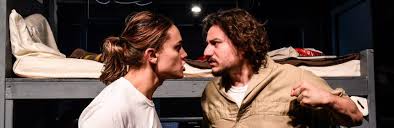

The state of the United States prison system is no laughing matter, especially when it comes to LGBTQ+ people, so I guess it’s fitting that the script of New Colony Theatre’s Punk, now playing at the Den Theatre, about a unit in a maximum security prison just for GBT folks, hardly gets close enough to a laugh to sneeze in its general direction. What it does offer, instead, are raw and honest portrayals of (mostly) nicely established characters, a strong production, and the hardest working Assistant Stage Manager in Chicago, all working in order to make the most of a flawed script.
Michael Allen Harris’s new play has its powerful moments; there is no doubt. His ability to write clever dialogue pops up again and again, most notably in a scene in Act Two in which all of the characters are involved in separate conversations that appear to miraculously spiral around each other. And he has certainly chosen territory ripe for exploration: a card in the lobby runs off statistics about life in prison for LGBTQ+ people, and none of it is pretty. Whatever you think you know about prison, take it and at least triple it: you’ll be in the ballpark.
Unfortunately, Harris’s play contains a grenade at its core that destroys the credibility of the whole thing because it is the central conflict. Monette McLin’s Miss Olivia, keeper of the ward and defender of her “clients,” receives orders from the Warden that her budget is being stripped by a third because he needs the money to house inmates from the general population among her people. Meanwhile, ten of her GBT folks will go back to GenPop, a “death sentence” according to Olivia.
Now before I go on, let me make a disclaimer: I know nothing about the inner working of a prison system; thus my reactions are based on my thoughts alone, rather than any kind of researched knowledge.
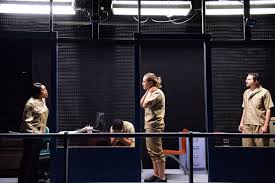
The problem with this conflict is that it is ridiculous: the Warden has x-dollars to spend. He has x-inmates to house. Logically, it should make absolutely no difference which cells he houses them in. The budget would not be affected either way. And even if it were, his prison holds what we are told is the only GBT-dedicated unit in the country, a unit that has had zero instances of violence in two years (a statistic that is not only incredible but must also logically affect GenPop because the GBT people who’d be picked on are not there). You know that this unit has been written up in papers across the country. The Warden is the anti-Joe Arpaio. In the real world, he’d be famous. And he’d never harm the goose that laid that golden egg.
Kaboom. That’s the sound of a plot grenade going off. So, on its face, the script has a deep flaw. Then Harris gives it a second one: he has the Warden move a gay-killing inmate (Travis, played by Daniel Shtivelberg) into the GBT unit. Ostensibly, this is to protect Travis, who has been targeted by gangs in GenPop. But the chaos it will likely cause to the like-clockwork GBT Ward just isn’t worth it, and our anti-Arpaio seems to be the only person who doesn’t realize it. Kaboom again.
So what do we do with a play whose central conflicts make no sense? Well, if you are cast in it, you act the crap out of it; that’s what. And that is what this small ensemble does. Besides McLin and Shtivelberg, that ensemble consists of Kyle Encinas as Glenn, a somewhat shy, manga-writing inmate, Evie Riojas as Sonya, a transgender woman housed in a men’s prison against her desire, Aaron Sanchez as Georgia, who is either an extremely effeminate gay man or an extremely pre-hormone trans woman (I was never sure which), and Keyanna Khatiblou as Emily, Travis’s ex-girlfriend. Each one of these actors has more than one great moment to play with, and all acquit themselves well.
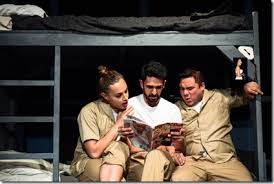
Riojas as Sonya is the central figure among the original “clients.” Although feminine (to the point of creating her own make-up from crayons, colored pencils, and whatever she can find), she is also imposing, and it is clear that she is the one of them who is “in charge” on the ward. She is also the one with the tightest relationship with Miss Olivia. McLin (who on this night seemed to have some issue stumbling over lines) is powerful as the ward officer who cares deeply for her charges, refusing to call them “inmates"and treating them as “family.” In one bright moment, Olivia fantasizes kidnapping the Warden’s family and forcing him to accede to her needs. A later scene in which things go terribly wrong on the ward allows McLin to show how hurt and upset Olivia is as well as how frightened she is of the sudden danger she has not seen here before. It’s a nice piece of acting.
The other two members of the “family,” Sanchez and Encinas, complement each other nicely. Cellmates (I first typed “roommates, a nod to how friendly the environment is made to appear), they have their differences, but each supports the other, whether it is Georgia trying to calm a depressed Glenn or Glenn chatting comfortably with Georgia as he does with few others. An early exchange between them provides some character background.
Glenn: (My father) has to sit across from me and face his disgrace and shame.
Georgia: “Your father hates you but at least you weren’t homeless...I’d settle for at least.”
And each performance has some showy elements. For Sanchez, it is the affectations the role is rife with, as he perfectly portrays Georgia’s feminine side (whatever it may be) while rarely allowing emotion to escape because emotion hurts. For Encinas, his Big Moment comes in a late scene in which his character confronts Travis. Enhanced by some fun effects, Encinas goes to town and takes the bigger man down several notches.
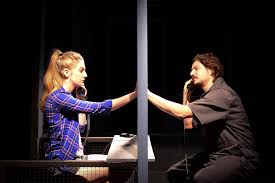
Speaking of Travis, Shtivelberg’s performance is easily the most complicated, as he plays the least likable character but one we also are meant to feel a bit sorry for. Travis has a daughter back home, one who is not being well cared-for by a self-centered, junkie mother (Khatiblou: watch her after their scenes together; she’s marvelous), and there is nothing he can do about it. Of all of the characters, Travis travels the furthest emotionally, but it is odd that, in the end, I didn’t feel I really knew him. I blamed Harris’s script rather than the performance for this: Shtivelberg does everything he possibly can.
Still, one aspect of that script shines, and that is the emphasis on being seen as you are. In a conversation between Travis and Glenn, the former says that he can tell that Glenn is a master at showing others the version of himself he thinks they will like. When we take a step back, we realize that they all are. Sonya, a brutal killer, is showing herself as a calm problem solver. Georgia is not allowing anyone to see inside to his own pain. Travis can only exist in this ward by hiding aspects of himself. And Olivia is a bit of a psychological mess herself, which she must hide from everyone. But it is this need to be seen that means the most to Glenn, who tells of one person in his past:
He gave me the time of day and that means something to someone whose afraid to see his own reflection.
Diana Raiselis and Katrina Dion co-directed on a very clever set designed by Eleanor Khan, and they breathe real life into Harris’s words. (One excellent moment, whether theirs or Harris's: showing Sonya working out before she takes on someone bigger than she is.) And Khan’s set, in which various elements slide out and open up, offers quite a challenge for ASM Samantha Corn who, dressed as a prison guard, spends the entire evening pushing large wooden platforms twice her size around the stage. I can’t recall the last time I gave an ASM a shout-out, but I’d be completely remiss if I didn’t in this case. Every aspect of the production supports the cast in their efforts, but one more shout-out has to be reserved for Jeffrey Levin’s sound design. From the start, the music, the loud noises that resemble harsh prison sounds, the buzzers, the ticking clock and scratchy phone when Travis speaks with Emily: everything Levin did works beautifully.
In all, the acting and the production save the play, which needs saving. It’s an important topic, but one that might better be served by a play that had a central conflict worthy of its characters.
Punk is now playing at the Den Theatre, 1333 N. Milwaukee in Chicago, through Nov 5. Tickets are available from New Colony; half-price tickets are available.Find more information about this and other plays at theatreinchicago.com.