
Review: A Funny and Disturbing Evening at the Talkhouse
 There are two things you know for certain when the play you’re about to see is written by Wallace Shawn: first and foremost, that it will be full of clever dialogue and wordplay; and second, that it will likely be provocative. An Evening at the Talkhouse, now playing at A Red Orchid Theatre in

Old Town, does not disappoint on either score. And if the cast is up to the task, as it is here, the audience is in for a memorable night at the theatre.
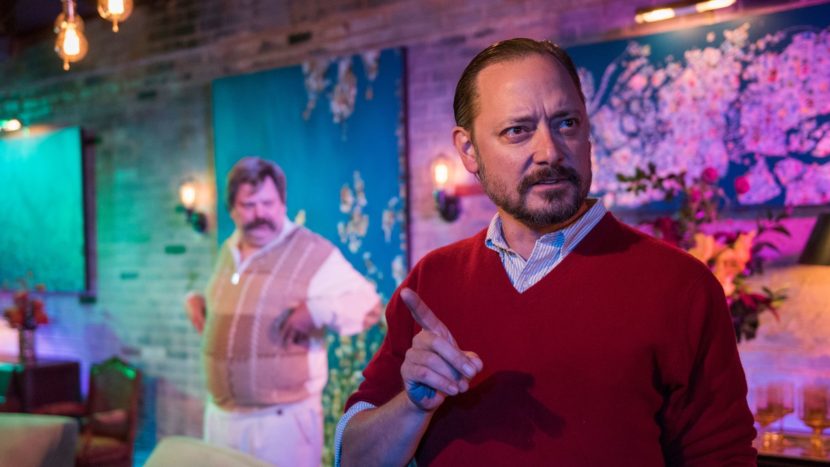
Stepping into the chilled interior of the theatre (A Red Orchid is notorious for starting out frigid before warming up), one feels immediately comforted by photos and art on the walls and plush furniture onstage arranged for actual conversation. We’ve arrived at the site of the title, an old-fashioned club where several people who worked with each other on a play a decade ago are to meet for a kind of reunion. It’s a celebration of a piece whose author, Robert (an effete, world-worn Lance Baker, drily appraising everyone and everything and usually finding something lacking), acknowledges was, despite being his “best work,” not “all that successful.” And as he introduces the members of this “nostalgic” event, it’s plain to see he detests pretty much all of them, and pretty much all of them have bones to pick with each other.
Should be a swell reunion.
In addition to Robert, we meet Dick, played with marvelous physical gusto by H.B. Ward, who comes to the reunion both drunk and periodically wretching loudly and throwing his arms around like a wild man. His face, too, is covered with bruises; this has not been his year life.
I was beaten rather recently by some friends, but you see, I actually enjoyed it very much in the end...It’s not what you think. It was quite fun, I’m serious. Well, it was a rather short battering. You know, informal.
If there is one character other than Robert who is central here, it’s probably Dick. Everyone else sees him as a lost cause (including, apparently his friends), and it is true that for most of the play he either sleeps or lumbers about partially somnambulistic. Dick, of course, insists that there is nothing wrong. “I haven’t changed; everything else has changed,” he complains. Dick tries to laugh through his pain and pretend to be positive, but his real emotions keep falling from his mouth:
This reminds me of one of those nights when you sleep in an overheated room--you know?--and you dream you’re surrounded by every horrible person you ever met in your life.
Dick has never had strong connections. Robert blackballed him from the original play because he was so unimpressed by Dick’s acting chops. The others aren’t even sure why he’s here. Is it just to cause trouble? And when they discover that Nellie, (Natalie West, who brightens every scene she is in) the kind woman who runs the Talkhouse, is allowing him to stay here, each of the others reacts in different odd, but clearly negative, ways.
Most of that has to do with one of the objects of Shawn’s satirical invective. A very tight playwright, he rarely loses his focus and his comments are clear and often biting. And in this play there seem to be three central objects of satire: first, the impulse to have (and attend) this kind of fake reunion in the first place; second, the world of theatre in all of its self-righteousness and false veneer; and finally, the American political scene. This is not your father’s—or your—America. Its excesses may be based on the extreme madness pervading our politics, but it becomes quickly clear that this world is some alt-Earth on which elections occur with alarming frequency and are always won by the same man, a brutal dictator named Ackerley who nonetheless is liked by many for presiding over “a more tranquil era.”
Under Ackerley’s rule, silly sitcoms are in and theatre, which (as this play becomes a perfect example) is designed to make you think, is out. Even if someone wrote and produced plays, no one would go to see them. “People stopped seeing plays because they got too sad and miserable,” says Annette, the one woman at the reunion who doesn’t work at the Talkhouse. Kirsten Fitzgerald plays her very buttoned up at first, but lets her hair down (metaphorically, anyway) as the evening wears on (and she’s had a few drinks?). But even if it’s true that no one sees plays anymore, that suits playwright Robert just fine.
Because what exactly *was* theatre, really, when you actually thought about it? You’d have to say it was utterly and irreducibly about a small group of humans sitting and staring at another small group of humans…
At some point, it lost its magic for Robert, and now he writes unabashedly for a sitcom starring the man who took the part Dick wanted, Tom (Miguel Nunez, who might well have faded into the background if it hadn’t been for his accent, which may well have been the point: despite everyone’s opinion, it is never clear at all that Tom is, in fact, the better actor).
And it is when Ted (Doug Vickers, who brings calm and clarity to the gathering) begins speaking of the comfort factor of joining “one-member clubs,” (they are “the latest thing,” he tells everyone: you never get in anyone’s way), that this play dives straight down the rabbit hole. Apropos of absolutely nothing, this piece of dialogue finds its way past the silliness: “The program of murdering gets bigger every year” because the people in rural areas want it.
The program of murdering?

Once this is explained, it appears at first that they are speaking of something like drone strikes in distant lands, and they are...partially. But “the program of murdering” goes far beyond that. These struggling artists have (all?) been recruited as “targeters”: people who go through all sorts of names and information and statistics and literally decide who the government should kill. And some of them, we’re told, are given the extra responsibility (for extra money, of course) to be the murderers themselves: they are told who and how and where, and they just...do it. No questions asked.
It is Nellie who asks the crucial question: “What if everybody started targeting everybody?”
They speak of a nationwide love affair with TV shows featuring murders. And they tell stories: two people who were targeted actually went into a bathroom, made loud, strange noises, and then just died. Meanwhile, Jane (Sadieh Rifai, in a thoroughly likable performance that belies the outrageousness of some of the things she says), Annette, and Bill (Noah Simon, who slips into the background at first but emerges as a strong voice later on) fiercely advocate for the humanity and necessity of targeted murder. And when Jane states, calmly, “I don’t know how much longer (Dick) is going to be allowed to live,” we realize that this is not some abstraction or something only overseas. In a nation in which everyone is fascinated with murder and empowered to target others, it’s natural to be concerned that your neighbor might target you. Perhaps Ackerley’s “more tranquil era” is due to paranoia?
The ensemble, ably directed by Shade Murray, is more than up to the material, though the material leaves you feeling a bit overwhelmed. Shawn’s play ends so suddenly that I am convinced that the cast has a side bet each night on whether the audience will react before the closing music (“Everybody Wang Chung Tonight”) begins. On this night, those with the “no” bets would have won. Which doesn’t mean it is a bad ending: it leaves us hanging because the world in which they live is impossible to predict. And it stays with the audience long after they have left the (now quite warmed up) theatre.
Evening at the Talkhouse is now playing at A Red Orchid Theatre, 1531 N. Wells in Chicago, through Nov 19. Tickets are available from A Red Orchid Theatre. Find more information about this and other plays at theatreinchicago.com.