
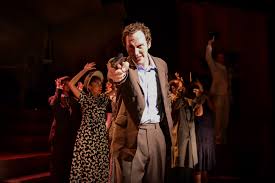
Since the first time I encountered them, I have come to expect that a night at a Kokandy Theatre Company production will be a night well spent. Bonnie and Clyde is certainly no exception: the play is an intimate, emotional examination of two of the most famous outlaws the country ever produced, and this production is about as personal and at times poignant as I can even imagine for a show involving so much gunfire.
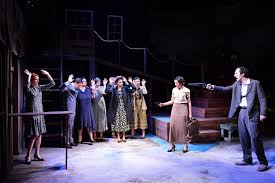
Oh, there is gunfire. Tons of gunfire. But what can one expect when dealing with these notorious gangsters who robbed and killed their way across Oklahoma and Texas during the Depression and went out in the blaze of a lawman ambush? In fact, the play opens with that assault, and the first image we see is the bloody bodies of our two protagonists, slumped against each other in a final embrace, before we briefly jump backwards in time to the children they were: 10-year-old Bonnie dreaming of being the next Clara Bow (Tia L. Pinson, in a cute turn) and 12-year-old Clyde (Jeff Pierpoint), already a rapscallion, dreaming of what he can do with a gun.
Young Clyde’s heroes are Billy the Kid and Al Capone; it’s easy to see that this product of poverty and anger is headed the wrong way from the beginning. But Bonnie only wants to go to Hollywood, and like a true actress-to-be, takes on a career as a waitress. In a “meet cute,” Clyde tells her that “this world will remember me” before pushing precisely the right buttons by claiming that “you’ve got that it-girl look.” Bonnie is in love almost from the start.
However, like the other female protagonist, Buck Barrow’s wife Blanche, Bonnie (played as an adult by a powerful Desiree Gonzalez) spends a long time trying to convince him to go straight. With Clyde’s brother, fresh out of prison himself, it may work. With the much wilder Clyde (Max Detogne, giving an angry but nuanced performance: we can see his love for Bonnie all the way through), Bonnie hasn’t got a prayer. As he tells his brother (Cisco Lopez), “It don’t make no difference what we do; the law keeps coming after us.” His philosophy is laid clear when he says, “I ain’t never gonna be set free. Freedom is something I got to steal.”
As to Bonnie, it is clear that they are perfect for each other from the beginning because she will take nothing from him. At one point, he slaps her. Her reaction? She slaps him right back: outlaw partners being born. There is a running gag about whether they should be called “Bonnie and Clyde” or “Clyde and Bonnie”; the fact that she wins this battle says it all.
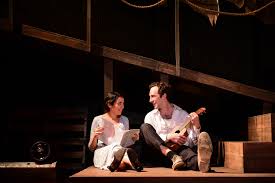
Detogne and Gonzalez share several gloriously intimate moments together, some of which involve her reading him poetry she has written, but one of the best and most powerful is a turnabout: him singing her a song he has written for her. That it comes just before the final showdown that leads to their deaths makes it all the more poignant, and director Spencer Neiman’s simple staging here calls the juxtapositioning of their violent lives and their deep and abiding love into focus. Bonnie’s powerful lyric says,
Dyin’ ain’t so bad not if you both go together
Only when one’s left behind does it get sad
A short and loving life, that ain’t so bad.
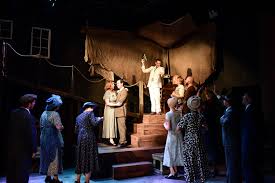
Throughout the play, Neiman keeps us reminded in scene after scene that this “short and loving life” is exactly what these two people got, and he pulls no punches: we see them in all of their anger, their love, their violence. In short, we see them in their human contradictions. And Neiman uses Ashley Ann Woods’ multilevel stage strewn with pallets and crates to every advantage. In several simultaneous solos, we see people on different levels. In large crowd scenes, the levels overflow. Different parts of each level become recurring locations. The stage pictures are often elegant.
This is especially the case in a couple of places. One is the scenes involving the Preacher, played by Nathan Carroll. The Preacher acts as a kind of moral narrator, appearing at various points and, in Carroll’s powerful voice, singing of the role of God in all of our/their lives, a commentary on the fact that the outlaws have become folk heroes. There is some great choreography here by Aubrey Adams and several really powerful moments.
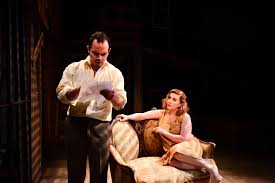
The other place where Neiman shows himself off is the beautiful, quiet moments between Buck and Blanche. Missy Wise gives a tremendous performance as the woman so desperately in love with her husband that, good soul though she might be, she will eventually go with him when he joins his brother just to see that he is safe. Her songs are among the show’s most powerful and personal, and two of her scenes stand out: the first occurs almost completely on a small settee where she and Buck rekindle their love. The second comes near the end, and I won’t spoil it except to say that you will rarely see acting any better. Lopez in that scene is pretty damn fine himself. (Jaq Siefert is listed in the program as “Intimacy Choreographer”; given that, I have to think he had a hand in both of these scenes.)
Every aspect of this show is outstanding. Lighting and sound play important roles in scenes like the manhunt. Ensemble actors are all outstanding. (Shout out to Ann Delaney, whose Trish has a fantastic moment during “You’re Going Back to Jail.”) Robert S. Kuhn’s costumes are perfect, especially in the scene in which Bonnie and Clyde pose for their famous photographs. (You’d swear she was wearing the very same dress.) In all, this is another powerful, outstanding effort from Kokandy, which has become one of the most consistently excellent and entertaining ensembles in the city.