
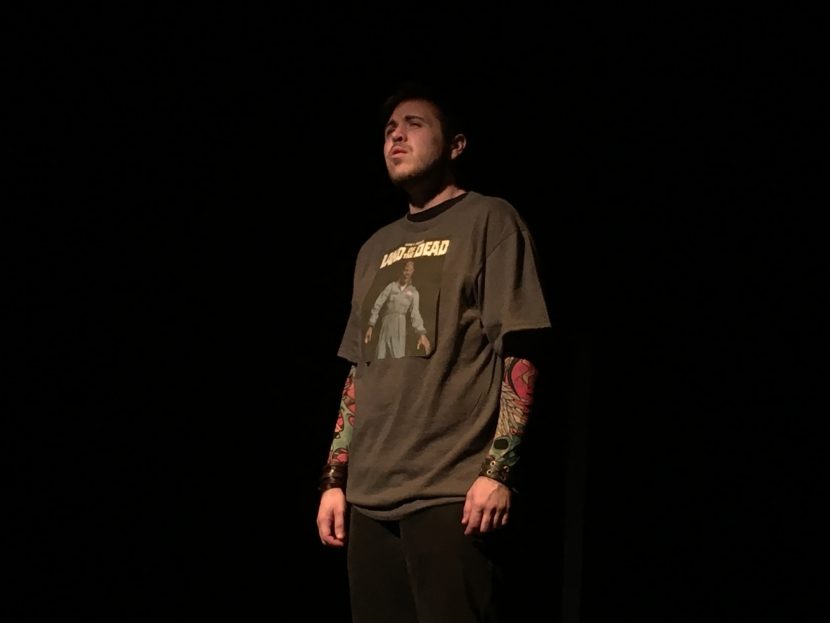
 Putting on an original musical is an enormous undertaking, especially for a brand new company with little financial backing. More often than not, it’s an act of love, and actually getting the show to the stage and in front of an audience is an accomplishment of some note. How much more of an accomplishment must it be, then, when that original musical proves to be a very entertaining endeavour. And judging from the audience reaction to opening night of Zombie Bathhouse, now playing at Center on Halsted on a staggered schedule through the end of the month, it appears that Brian Kirst and Scott Free have written a winner.
To be sure, there are many flaws in Zombie Bathhouse at this stage of its existence, many of which stem from poor timing and pacing on scene changes. If director Dan Foss eliminated the blackouts and instead used Shakespearean scene changes, the whole thing would move faster and feel much tighter. Lights were also misplaced on opening night, an issue caused by a speaker using the space earlier. But despite the flaws, which we can hope will be resolved as the run goes on, the show is definitely likable.
At this point I need to interject a full disclosure: North Rory Homeward, who plays the main character of this show, is my son. Had someone else been available to review the show tonight, I’d have insisted on it. But no one was, and the duty falls to me; I will try to be as objective as possible.
The story revolves around a mysterious bathhouse in which three gay activists disappeared in 1970 and have never been seen again. (A completely unnecessary and very confusing flashback attempts to show us the cause at the start of Act Two. We already know what we need to know, and the scene merely stumbles and gets in the way.) The activists, Ash, Scrimm, and Quigley—the names: one zombie-hunter and two stars from horror movies of the 80s—never left the bathhouse; instead, they have lived within its walls for half a century as zombies. As the play begins, it is Pride Day and three young men are about to enter The Man Vault for a night they will long remember
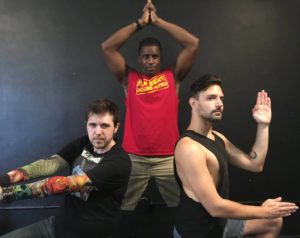
The men are Michael, Jason and Freddy—yes, the names are those of 80’s horror movie killers—best friends out to try to tap into the day despite it causing angst to Jason and dread to Michael. (Freddy, we quickly learn, is ready to go with anything that happens along.) These “inseparable” buddies are separated almost as soon as they enter The Man Vault, which is when things start happening. Michael, there only to DJ for the night, meets zen-like zombie Ash and immediately falls for him, not knowing his true nature. Jason reconnects with his one-time lover Vinnie, the Vault’s manager. And Freddy? His playful nature leaves him perfect prey for Scrimm, the one zombie who seems to be malfunctioning and (instead of living on sex as the others do) desires a more “traditional” diet. (With all of the show’s meta-humor, I found myself wondering if they were going for some ironic twist to cast a relatively small actor, Shamus Jarvis, in the namesake role of Angus Scrimm, known for his portrayal of the Tall Man in the Phantasm movies. Maybe I’m overthinking.)
Outside, waiting for the friends to emerge from the bathhouse, are Michael’s mother Doris (Melissa Van Kersen); her “rainbow set-up” for her son, Bruno (Michael Cadville, who has one of the funniest songs in the play with “Alone Together”:
I could hold my hand and you could hold yours together…
Our inner voices could talk for hours
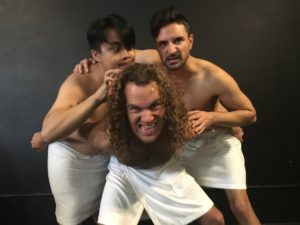
and nails it); a reporter (Anna Siebert) who is sure there is something odd going on, and a tour guide, Sophie (an ebullient Taylor Raye) who seems to know more than she lets on…and she lets on a lot. In fact she tells the entire story of the bathhouse mystery (with the missing activists she refers to as “the Amelia Earharts of the LGBTQ community”) in “We Honor the Dead” and somehow has a map to the building and a massive set of keys, one of which just might get her in if need be. And when word gets out that zombies are eating people, that need materializes.
The play itself, as written and currently directed, may have a few kinks, but there is nothing wrong with the acting, thesinging, or Scott Free’s songs. (In the middle of Act One, I found myself wishing I could have a soundtrack for this show. Imagine my surprise to find them for sale in the lobby when it was over.) It all begins with Michael, portrayed by Homeward. In his first starring role in a musical, he does a fine job of portraying a gay man haunted by the trauma inflicted upon him by a misguided Doris when he was a teen. (His visions of a “conversion” doctor are vivid and sometimes rather frightening.) From the first time we see him, Homeward’s character is out of sync with everyone else’s celebration, even his mother’s and his friends’. He only truly feels comfortable in Jason’s and Freddy’s presence; otherwise he is a half-step from lost.
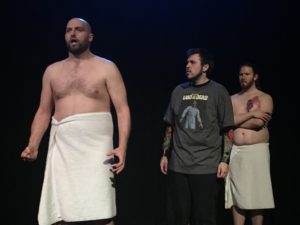
In fact, in “The Muffin Song” at the start of Act Two, Michael sings of the pain of never having been loved deeply. Homeward’s deep, moving, plaintive voice crafts the song into something that calls out his hurt until Michael gives up and laughs off the lunacy of it all near the song’s end. Contrast that with the darkness Homeward conjures in Act One’s “The Horrible Laughter,” a song about the nightmare visions that haunt him, and a sense of this young actor’s dynamic possibilities arises. If he could just work a bit on the dynamics of his character’s reactions to the “dread” of Pride in the show’s first ten minutes and find a few different reactions to the Doctor, he’d be just about perfect in this role: his ability to portray a depressed and anxious mind is considerable.
This is why his instant connection with Ash (an imposing Dennis Frymire) is so significant. Frymire imbues his character with such depth that Michaelgains perspective just by being near him. He is Mr. Insta-Calm, despite the fact that, like Michael’s, his songs reveal a lot of personal pain beneath the zen exterior. Between “Years and Years and Years” and “Dead on the Inside,” Ash reveals that living this non-life has left
him a shell of who he once was. He may need Michael as much as Michael needs him. But it is his Act One ending song, “Monster,” that reveals the truth about how he sees himself now.
As to Michael’s other friends: Jason (Marc Prince) alternates between being a deeply self-contemplative but confident police officer and a strange caricature of one. In the self-loathing “I Am Not My Type,” the athletic, body-building Prince sings a similar lyric to the more pedestrian Vinnie (Adam E. Hoak, whose plaintive “Keys to Their Happiness” brilliantly establishes him as another very lonely gay man, a theme pervading this show although it brings all of its poor unfortunate souls together in the end), showing that it doesn’t matter what your body type might be: anyone can have issues. Most of the time, though, despite his personal pain, Jason still comes across as possessed of at least his sense of who he is as a cop; but later, when trying to lead Vinnie away from a hoard of hungry zombies, he seems to forget his training entirely, even losing his gun and leaving it lying there. (This crucial plot point seems rather contrived, especially when you consider it is a cop doing it.) I have to say, though, that Jason’s “happy day dance” when he reconnects with Vinnie is a small gem.
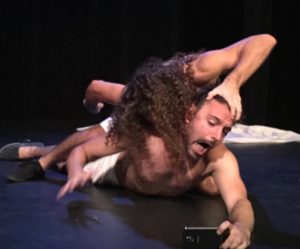
As to Freddy, he’s zombie food. But he’s having the time of his, um, death? (Even as he is being attacked, he wants the world to know that this doesn’t mean he’s a bottom.) And along with Scrimm (Jarvis has more fun in this play, I think, than anyone) and fellow zombie Lionel (Val Garcia), he gets two of the great highlight songs of the show, “Man Meat” and “Save the Earth/Kill a Human,” anthemic pieces sung by zombies on the prowl. These three killer zombies are creating quite a problem for Ash and the oddly underdeveloped Quigley (Brian Mengler): with people dying, The Man Vault may end up closing down, big trouble for “The Regulars,” as the zombie residents style themselves.
Another tour de force is Doris’s “I Love My Gun,” a high-speed number about loving her son that Van Kersen absolutely rocks.
You mess with him, you mess with Momma
Don’t you mess with Momma
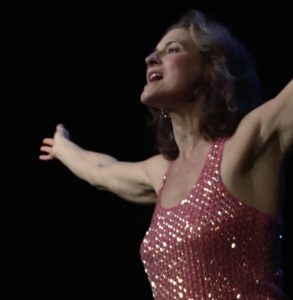
For most of the play she has been a solid comic character; suddenly she emerges as a force of nature, and the writing here couldn’t be better: we need to see her that way since she figures significantly in the play’s ending, which culminates in a huge wedding sequence featuring a song called “Death Do Us Part” that I am still singing to myself as I write this.
Zombie Bathhouse is not yet in a condition in which I can recommend it, but I believe it can and will get there. The flaws I saw on opening night were significant but can be easily overcome as this strong ensemble starts to gel more. One advantage of my “inside knowledge” of the play is that I know it was undergoing revision almost until the last minute, even replacing an actor the night before it opened. With more stability in these areas, the actors and director should be able to bring the issues under control. I look forward to seeing it again a bit later in its run.
chicagodramagirl