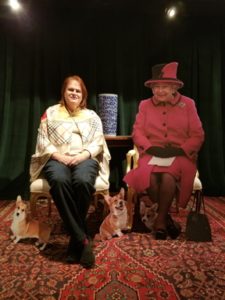

When it comes to Queen Elizabeth II, there is probably no contemporary writer who knows more and is able to convey it with more humanity than Peter Morgan, author of The Queen and The Crown. He has made Her Royal Highness a focus of his most recent work, and his works consistently reveal the humanity behind the mystery of the royalty. His 2013 play The Audience, which starred Helen Mirren when it premiered in England and when it briefly played in Broadway, has now been brought to Chicago by Timeline Theatre, and this production is a revelation. In the same way that Morgan strips the Queen down to her humanity, Timeline’s intimate production strips his play down from the theatricality of the West End/Broadway version with its huge cast, its many costume changes, and its corgis, to the basics of what it is about: two people meeting to talk in a private room. Timeline has configured its space in the round for this production, the audience surrounding four chairs scant feet from them, the only nod to aristocracy being the showy chandelier overhead. Everything else in the opulent space is imagined: it reminded me of Marriott Theatre’s similarly scaled-down Miss Saigon from a couple of decades ago, another play that benefitted tremendously from the powerful intimacy of a small space.

Janet Ulrich Brooks plays the Queen in this incarnation of the play, and she is thoroughly marvelous. With only the barest of costume changes (a jacket, a cardigan sweater), she manages to suggest Her Majesty at various points across six decades of her rule as she meets with eight of her (currently) thirteen Prime Ministers in their weekly private audiences. There are no transcripts for these audiences; Morgan’s script derives from his imagination fueled by reports and allusions to these conversations from the various PMs themselves. In it, he captures the Queen’s growth from naïve young ruler being taught protocol by Winston Churchill to well-established matriarch learning to enjoy the company of Harold Wilson to frustrated world leader at the mercy of the iron will of Margaret Thatcher (Wendi Weber, all officiousness and irritability in a scene about a day on which the Queen apparently has defied her), and Brooks is up for it all. No matter who is onstage opposite her, she shines.
A highlight is her growing relationship with Wilson (Matt DeCaro). At first taken aback by the new Labor Leader’s brashness, informality and total lack of knowledge of how to behave himself in the presence of the Queen, she later becomes so enamored of him as to consider him as her personal favorite among them all. The scene in the castle at Balmoral is wonderful, first because it is in Scotland, and thus is the only scene not in the Buckingham Palace audience room, which makes it somewhat special by itself, but it is the fact that it involves so much movement and real interaction between the two that really sets it apart. And when he reveals to her his eidetic memory in a gentle and comic scene, the moment is real and the affection is real.

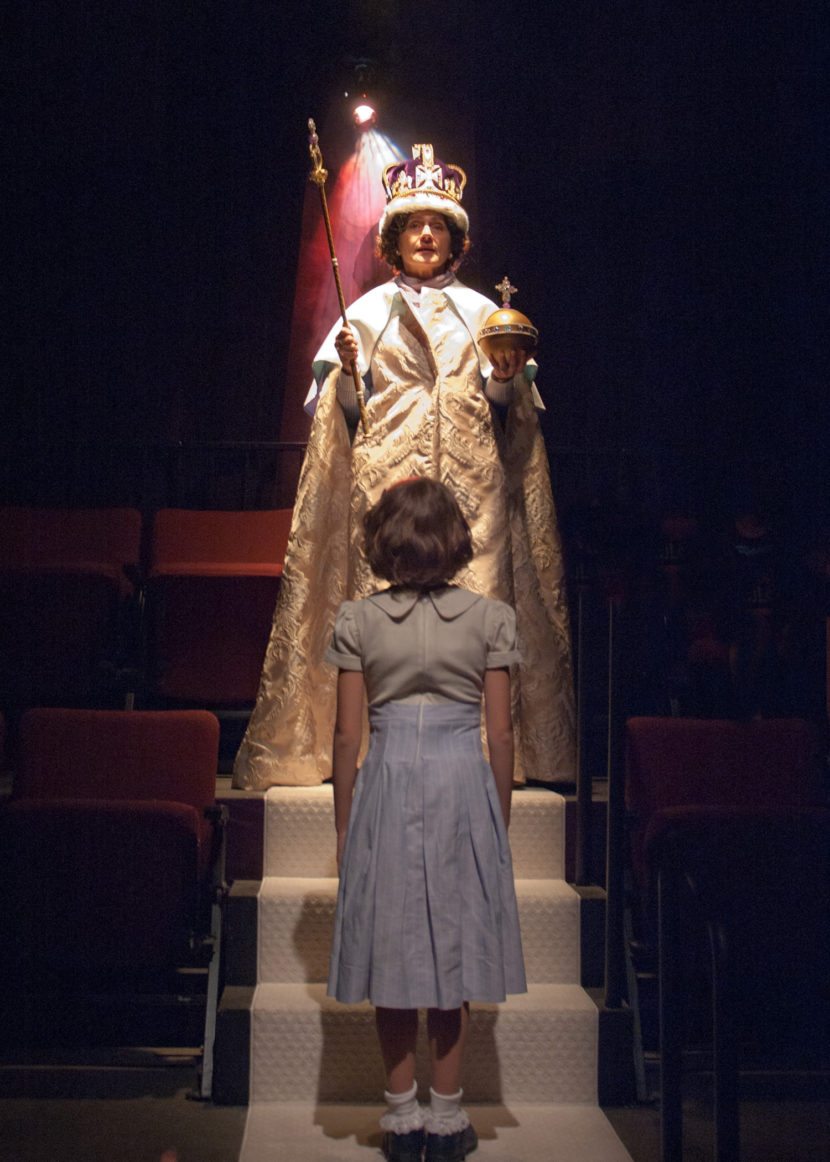
Brooks also has some lovely moments interacting with her ten-year-old self (played in the performance I saw by Audrey Williams, who shares the role with Sophie Ackerman). Williams, a letter-perfect young Elizabeth, first appears in a scene in which the child, knowing now that she is heir to the throne, discovers that her friends will need to bow or curtsy to her. Her first reaction is telling: How can we stop that? But, as she soon discovers, you can’t. It’s part and parcel of being Royal and she has to get used to it. The young girl’s frustrations appear throughout the play. Finally, her current self tells her the harsh truth: “Your ordinariness as a human being will be your greatest asset as a sovereign. A more distinctive, perhaps imaginative person would make a mess of it and crack under the pressure of the invisibility required to successfully execute the most visible job in the world.” Not what the little girl wants to hear, but as a description of a position that holds no real political power but all sorts of symbolic weight, Morgan’s line rings brilliantly true.
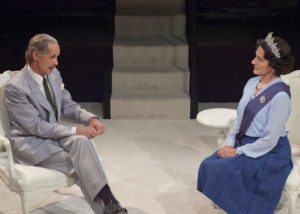
Other cast members also get their chances to shine. DeCaro also plays Tony Blair and Churchill, having considerable fun with both. Mark Ulrich plays four different PMs with a variety of hairstyles, hairpieces, and accents. What each of these has in common is not politics (three are conservative and one labor). The script notes that PMs don’t so much win their elections as the other party loses them. Though some of these men could claim some initial popularity, all of them collapsed in the end, and Ulrich’s portrayals provide indications of their general ineffectiveness. The script chooses to focus on Major’s 1995 “Sack me or back me” election, so the PM comes off as nervous and uncertain of himself. Eden, too, doesn’t come off well, which isn’t really surprising. Despite being described by the Queen as the most handsome PM she has ever worked with, one who had ladies lining up for the chance to see him, he had the misfortune to be in charge during the Suez Canal incident, in which his stunning ineffectiveness resulted in only a two-year term. Ulrich also appears as Gordon Brown and David Cameron, both of whose terms ended rather ignominiously as well. It is clear that he has tons of fun playing all of these men.
The final character in the play is Equerry, the Queen’s man played by David Lively. Lively serves as a kind of narrator, helping to set scenes, as well as the play’s only running crew, moving drink carts on and off of the stage as appropriate. His staid and steady presence is thoroughly British, everything we think we expect when we think of the Queen. That he is one of the only elements of the play that lives within that stodgy stereotype might have been telegraphed to the audience had they been paying attention to the whimsical preset music that included such inspired pieces as the Beatles’ “Her Majesty,” Lorde’s “Royals,” and Anne Stephens’ version of “They’re Changing the Guard at Buckingham Palace.” I don’t know whether it was director Nick Bowling, who deserves all sorts of accolades for transferring this play to this stage in such a brilliant manner, Sound Designer Andrew Hansen, or someone else who came up with this playlist, but kudos to them. It put me in the mood to see exactly what I saw: a Queen Elizabeth who was real and emotional and honest and, most of all, human.
The Audience is now playing at Timeline Theatre, 615 W. Wellington, until December 3. Tickets are available from Timeline Theatre. Find more information about current plays on our Current Shows page and at theatreinchicago.com.